Blog
Good Routes Don’t Stay Good
by Routeware Team • May 18, 2026

Here’s something most fleet managers know but don’t always say out loud: the routes they’re running today probably made sense five years ago. Back when the service area was consistent. Before that new subdivision got built. Before the fleet changed, or the service day shifted, or the contract expanded, or organics were added, or the operation went from four days a week to five.
Routes drift. They get patched, extended, handed off, re-sequenced informally, and quietly added to. Over time, what started as a well-designed schedule becomes something nobody quite designed — it just accumulates. And routes with ad hoc, bolted-on additions are almost always inefficient routes.
That’s the problem route management software exists to solve. And it’s an important one.
What “Route Management Software” Actually Means
The term gets used loosely, so it’s worth being precise. Route management software is purpose-built tooling that helps waste, recycling, and heavy-duty fleet operations design, edit, optimize, balance, and monitor their routes — without needing a GIS specialist or a spreadsheet with 47 tabs.
At its core, it covers four things:
Route digitization — Creating a structured, editable digital record of every stop, route, and asset. This is the foundation everything else builds on. Without it, you’re working from institutional memory and hoping your best driver doesn’t retire.
Route management — The ongoing work of keeping routes accurate and efficient as new stops are added, service areas change, or customers move. Most operations skip this. Routes get stops added but never rebalanced, and efficiency slowly bleeds out.
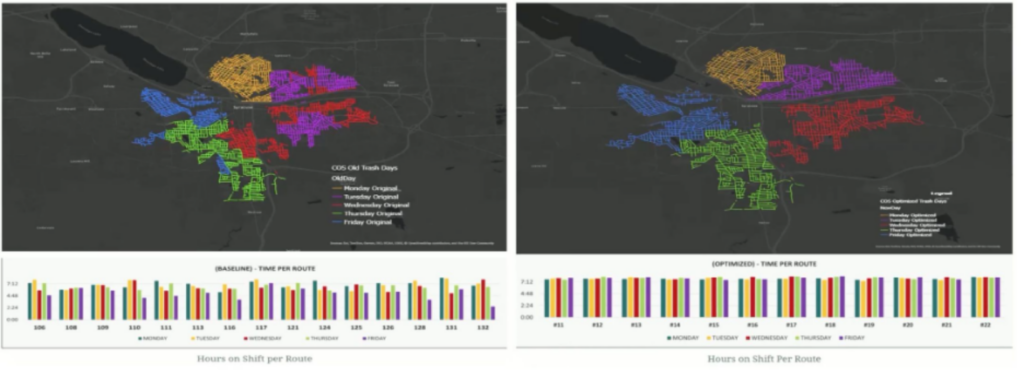
Fleet optimization — Balancing work across your trucks and crews so no vehicle is running a twelve-hour day while another finishes in five. This is where the biggest cost savings tend to live.
Dynamic routing — The ability to re-sequence stops in real time, reassign work mid-route, and handle the day as it unfolds rather than as it was planned — and when does it ever go exactly as planned?!
Together, these four capabilities compound in value. Digitization makes management possible. Management keeps optimization from becoming stale. Fleet optimization makes dynamic routing more agile. Together, they form the backbone of what a modern route optimization solution delivers.
The Problem Is Bigger Than One Route
One thing that comes up consistently when talking to operations teams — whether they’re managing a hundred routes in the American Pacific Northwest or handling 8,000 skip lifts a week in the UK — is the scale of the accumulated inefficiency.
It’s rarely one problem route. It’s the whole network, quietly drifting.
When Routeware’s fleet optimization team runs a webinar on this, they often start by asking attendees how they currently build routes. The most common answer, year after year, is still: manually. The logic being, our drivers know these areas — why change it?
The answer is that what your drivers know reflects how things were, not how they are now. As Ben Myers, a lead fleet optimization analyst at Routeware, puts it:
“Those routes that you had 10 years ago — and even four or five years ago — probably don’t reflect the best or most efficient manner to [drive] today. Whether that’s because of new streets, different housing subdivisions coming online, a change in your overall operation, or a new waste stream.”
The poll data from those webinars backs this up: overtime is consistently the top-ranked routing pain point, ahead of everything else. That’s what unbalanced routes do — they push some crews to finish at noon and others to work past their shift. And every hour of avoidable overtime is a cost on the bottom line.
Route Optimization Isn’t Just for Refuse Collection
Routing impacts any operation where vehicles follow scheduled routes — which turns out to be a much longer list than most people assume.
Residential waste collection is the obvious one, and where the majority of route optimization work happens. Residential collection routes are high-frequency, stop-dense, and sensitive to variability in pickup windows.
Commercial waste collection adds a layer of complexity: time windows matter more, container sizes vary significantly, and double-shifting — running AM and PM rounds on the same vehicles — requires a level of scheduling sophistication that paper simply can’t provide.
Recycling introduces new wrinkles around vehicle capacity and yield. If your recycling vehicle fills up faster on certain streets, that changes how you sequence stops and when you plan transfer trips.
Food waste rounds, which have seen significant rollout in the UK over recent years, are particularly interesting. The pick rates and yields for food waste don’t follow the same patterns as residual waste, which means you can’t just mirror your existing routes.
Street sweeping and snow and ice operations are increasingly urgent use cases for route optimization — and for good reason. Municipal operations teams don’t want three separate systems for waste, sweeping, and winter services. They want one platform. Routeware’s SmartCity solution handles all three, with route scheduling, real-time progress tracking, and driver navigation built in for each service type.
The Conversation That Changes Everything
Every operation that goes through a route optimization project says some version of the same thing afterward: we wish we’d done it sooner.
Not because the process is easy — it isn’t, and it shouldn’t be sold as such. Optimization requires data, planning, and a willingness to change pickup days that residents have known for years. Meridian Waste changed 5,000 people’s collection days in a single transition. That takes real organizational courage.
But the results are proportionate to the effort. Fewer trucks. Shorter shifts. More equitable workloads. Happier drivers. Fewer resident complaints. Lower emissions. A fleet that’s built for today’s service area rather than the service area as it existed ten years ago.
“When you change five thousand people’s collection day, it’s a big change. To be able to do it successfully speaks volumes of the [Routeware] tool. Especially in a pandemic.” — Patrick Messinger, Area President for South Carolina, Meridian Waste
The routes you’re running today will be less efficient a year from now than they are today, unless someone is actively managing them. That’s not a prediction — it’s just how routes work. The question is whether you have the tools to catch the drift before it compounds.
Route management software is how you answer yes.
This blog was an excerpt from an upcoming guide: Good Routes Don’t Stay Good: The Case for Modern Route Management Software
Learn More
→ See route optimization solutions → routeware.com/solutions/collection-operations/route-optimization/
→ For haulers: Routeware Elements
→ For governments: Routeware SmartCity
→ Watch: Intelligent Route Optimization in SmartCity (webinar)