Blog
The Truth Is on the Truck
by Aidan McLennan • May 4, 2026
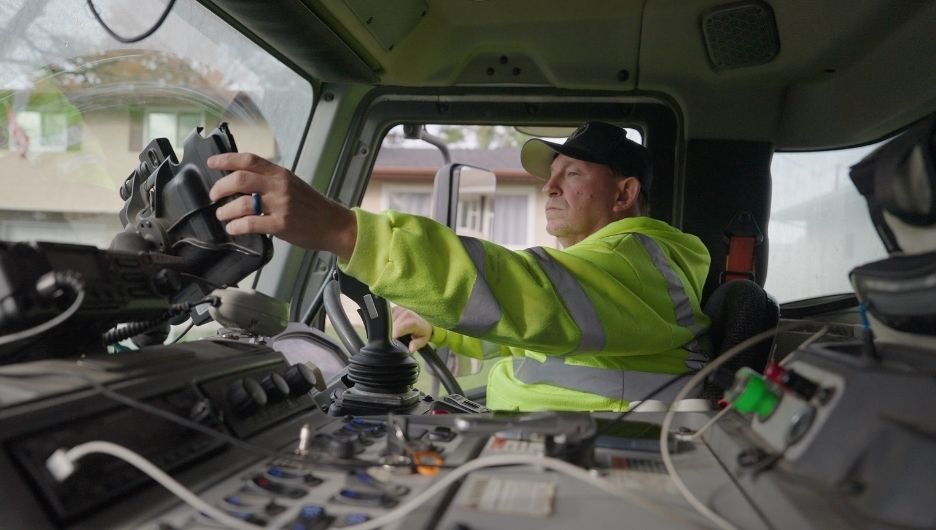
Every public works department (and private hauler) knows the call.
A resident reports a missed pickup. The driver says they were there. The supervisor has no way to check. So the city sends someone back out — an unplanned trip, an unnecessary cost, and at the end of it, someone is still wrong. Either the driver missed the stop and it won’t show up in any data, or the resident’s bin wasn’t out and the city just paid to avoid escalation.
For a long time, this was just the cost of doing business in waste and recycling collection. The word of the driver against the word of the resident, with no third party to settle it. To remedy this potential disconnect, some cities build buffer runs into their routes by default. Others rely on the goodwill of their drivers and the patience of their residents. Most do both. But there is another way.
With today’s technology, evidence is captured by the truck. Reporting on objective data the truck relays this info to the fleet back-office. No more guessing. Transparency fosters blame-free accountability.
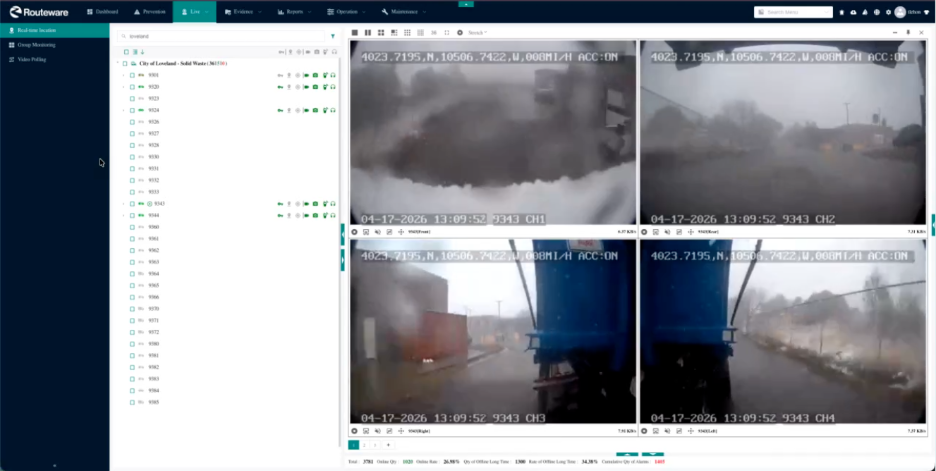
Two things happen when a city puts cameras on its collection vehicles
The first is the one everyone expects: driver protection.
A driver gets flagged for an accident that wasn’t their fault. Or a resident claims a cart was damaged at the curb. Or someone insists the truck showed up two hours late. Without video, a supervisor can investigate, but they can’t resolve easily or definitively. With video, the answer is generally very obvious.
“There is nothing more satisfying than having a customer call in to complain about missed service and having concrete evidence that their bin was not out,” said Minday Harpenau, Cofounder at Hillside Solutions. Jeff Martin, owner of American Refuse, put it this way: “We can see that a customer needs more service or that a cart is overfilled, and we can show the customer with a photo. It completely changed the dynamics of those conversations.”
That shift — from a dispute to a documented fact — is what makes camera systems so valuable to operations teams. It’s not about catching anyone doing something wrong. It’s about having a clear and confident answer when questions come up, and they always come up.
The second thing that happens is more operational, and in some ways more impactful: service verification.
When cameras are configured to automatically capture images at each stop — triggered by a driver interaction, a pounder button, or an automatic service event — you end up with a timestamped, GPS-located photo record of every pickup on every route, every day. Not a log entry. Not a driver note. A photograph.
Those photos are what reduce go-back trips. Routeware customers using in-cab cameras have seen go-backs fall by 35% on average. The same photo that exonerates a driver also answers the question of whether a pickup actually happened — all before anyone has to send a truck back to find out.
What the City of Loveland learned over eight years
Tyler Bandemer has been the Street Superintendent for Loveland, Colorado, for most of his career. He’s been a Routeware customer for eight years, and he’s watched the camera technology evolve from the ground up.
Loveland started with Routeware’s Picture Service in 2017. Back then, it was a snapshot-based approach where cameras triggered automatically at each stop. The photo would be attached to the service record, available in the portal for supervisors to pull if a resident called in. It was a significant step up from what the city had before, which was nothing.
“At first, the drivers weren’t sure about it,” Bandemer said during a recent Routeware webinar. “But once they realized it was protecting them — that when a resident called in and said they’d been skipped, we could show them a photo that said otherwise — they came around.”
His colleague Nathan Rasmussen, a crew supervisor with 30 years of experience, put it plainly: “A driver would come back and say ‘I serviced that address,’ and before we had no way to verify. Now it’s right there.”
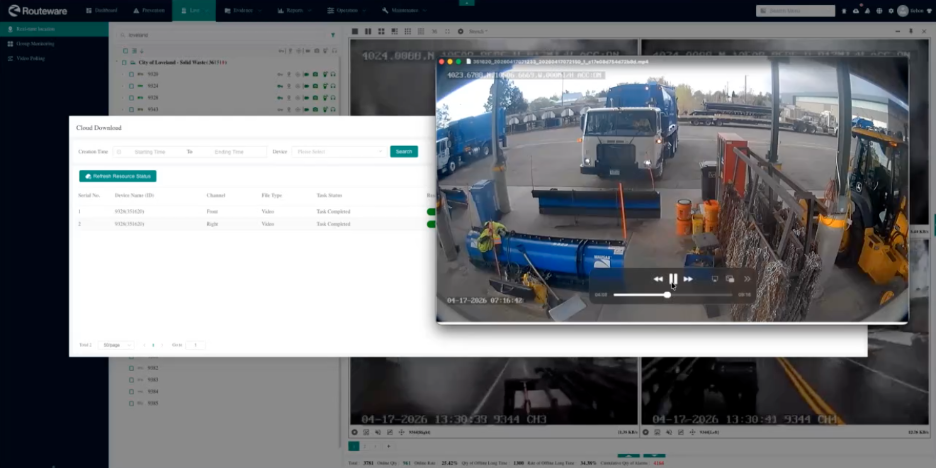
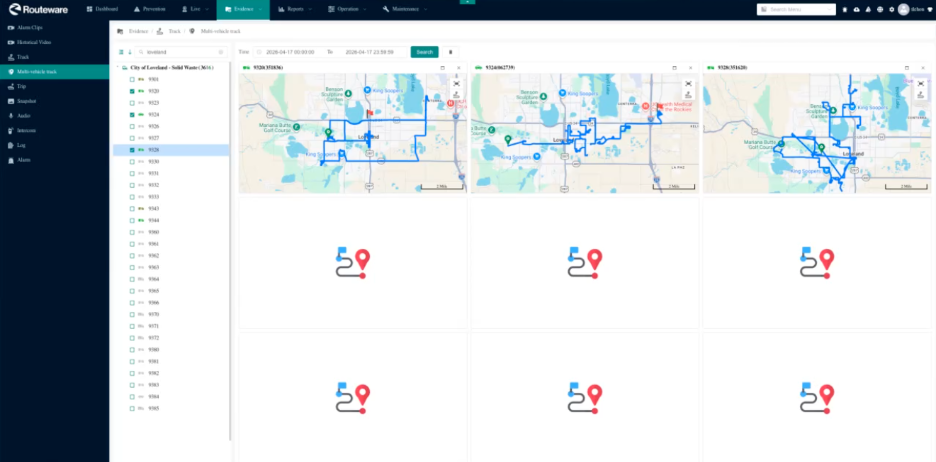
Over time, Loveland moved to Routeware’s Premium Video platform, a more comprehensive system with up to eight cameras per vehicle, live feed access over data networks, and full 1080p HD video available for download. The system stores footage locally on a 2TB SD card in a Mobile Digital Video Recorder installed on each truck, with a retention window of two to six weeks depending on settings.
The evolution matters because it shows how cities actually use camera systems in practice. Loveland didn’t start with the most advanced setup. They started with what solved their most pressing problem — service disputes — and scaled from there as the value became clear.
Live feeds, recorded video, and why each are important
One thing that surprises cities new to Premium Video is that the live view and the recorded footage serve different purposes, and they have different qualities by design.
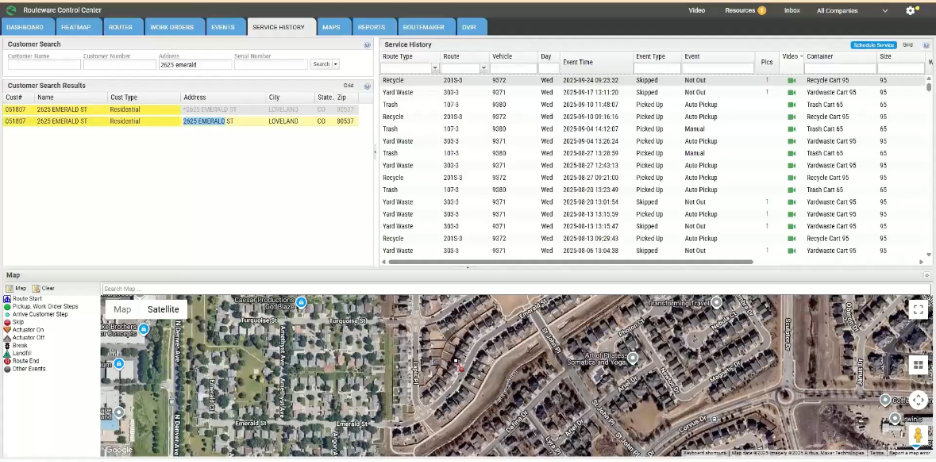
The live feed prioritizes availability over resolution. It runs at 480–540p because the goal is to get a usable image to a supervisor’s screen without buffering delays. If a truck is in the field and something goes wrong, the supervisor wants to see what’s happening now, not wait for a high-resolution stream to load.
The recorded video is different. When it’s downloaded from the MDVR — either manually by pulling the SD card or over the data network — it comes down in full 1080p HD. That’s the footage used for incident documentation, accident review, and anything where detail matters.
Camera angles are configurable but typically include a forward-facing view, a rear camera that activates automatically on reverse, and side cameras that trigger on left and right turns — the moments when collision risk is highest. Most vehicles run two to eight cameras simultaneously, all recording to the same unit. And because the MDVR has built-in GPS, every second of footage is tied to a specific location and timestamp. Route playback is possible: a supervisor can watch a driver’s full route from any camera angle, scrubbing through the footage the same way you’d replay a drive on a mapping app.
The numbers, in context
Four metrics tend to surface when cities assess the impact of in-cab cameras on their operations:
| Outcome | Average impact |
|---|---|
| Reduction in unnecessary go-back trips | 35% |
| Reduction in resident complaint volume | 14% |
| Time saved per route, per day | 22 minutes |
| Reduction in accident-related expenses | 25% |
The go-back reduction is the most direct: photo verification at the point of service means fewer trips back to service a missed bin. (If the bin wasn’t out in time, the supervisor can decide whether to make an exception and send the driver back — building goodwill with the customer — or, for repeat offenders, simply confirm the missed collection was the customer’s error and reassure them it will be picked up on the next scheduled round.) The complaint reduction follows naturally, because when a city can answer a service question with a photograph rather than a shrug, fewer calls escalate into formal complaints.
The time savings are less obvious until you consider how much supervisor time goes into fielding and investigating service questions each day. Twenty-two minutes per route sounds modest; across a fleet of ten vehicles running five days a week, it’s meaningful.
The accident expense reduction speaks to the exoneration use case: fewer disputed incidents that require legal review, settlement negotiation, or extended back-and-forth with insurance. Additionally, many insurers now incentivize fleets with cost savings when they include camera technology on their trucks.
“It’s not about what we say, it’s what the citizens say,” as Michael J. Shaw, Public Works Director at the City of Concord has noted. Camera documentation changes what citizens say because the question of what happened stops being a matter of interpretation. It also changes what they do when combined with enforcement, which was the case in Concord. Within a year of using the system, the city increased recyclables sent to the MRF by 15% in weight and diverted 3,000 tons of waste from landfills.
What Routeware’s camera system looks like today
Routeware currently offers two camera products for collection operations.
Picture Service is the entry point with automatic photo capture triggered at each service stop, available in the Routeware portal alongside the GPS service record. A supervisor investigating a missed-service complaint can pull up the address, see the route map, and view the timestamped photo from that stop in the same interface they already use for fleet management. Drivers can also trigger photos manually using a pounder button on the cab dashboard, which is useful for documenting exceptions in the field, like a bin that was contaminated or a cart left in a position that prevented service.
Premium Video extends this with full multi-camera video recording, live feed access, the MDVR hardware, and the 1080p download capability described above. The system also integrates with Samsara cameras for cities that already have Samsara hardware deployed, with access available directly within the SmartCity portal today. Integration between Premium Video and the SmartCity operations platform is on the near-term roadmap.
Installation is straightforward: approximately one hour per camera, handled by a Routeware technician or a qualified fleet installer.
The trust question
The resident complaint call doesn’t go away when you put cameras on your trucks. Residents still call.
What changes is what happens next. Instead of a supervisor who has to take a position on something they didn’t see, you have a system that watched the stop happen, recorded it, and filed the evidence automatically. The driver doesn’t have to defend themselves. The city doesn’t have to apologize pre-emptively. The conversation starts from a different place.
That’s the practical case for in-cab cameras. Not that it eliminates complaints, but that it eliminates uncertainty and saves significant time.
Learn more about Routeware’s in-cab camera capabilities at routeware.com/solutions/collection-operations/in-cab/
Watch the full webinar — including the City of Loveland’s experience with Premium Video — at routeware.com/resources/webinar-video/premium-video-picture-services-webinar/
 North America
  United Kingdom