Blog
AI in Waste Management: Putting People at the Center of Smarter Operations
by Katie Kinnear • July 10, 2026
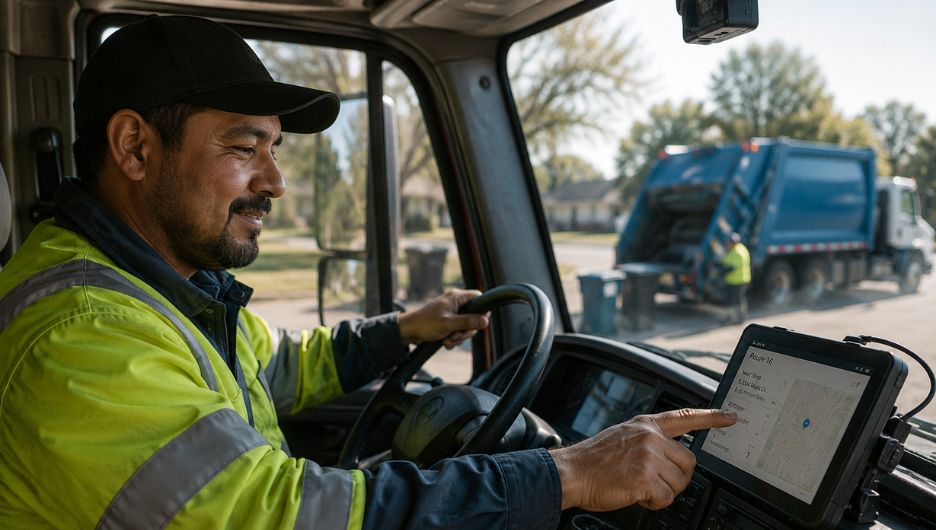
Cities are no longer asking whether AI belongs in waste operations. They are asking how to use it well. Across public works departments, AI in waste management is already impacting daily collection, recycling, and fleet management, and the departments getting real value from it share one thing in common: they use it to support their people rather than replace them.
When technology functions as a passive partner, it respects learned human expertise, including a driver’s knowledge of specific neighborhoods and traffic conditions. This methodology builds a deep layer of trust across frontline crews. By keeping operations intuitive, transparent, and grounded in real-world scenarios, cities can scale their digital capabilities without overwhelming the individuals who keep waste operations running.
Key Takeaways
- AI in waste management is already running in municipal operations, powering route optimization, contamination detection, predictive maintenance, and back-office automation.
- The strongest programs are human-centric, automating the data work so drivers, supervisors, and staff can focus on the job rather than replacing them.
- A collection fleet doubles as a mobile data network, capturing street-level data on contamination, potholes, and illegal dumping during normal routes.
- Cities that succeed start small, prove value on one or two trucks, and scale on results.
How Can Municipalities Operationalize AI in Waste Systems?
Operationalizing AI begins where the work happens, in the cab and on the route. For years, technology on waste vehicles focused heavily on safety monitoring, using in-cab devices and safety cameras to help operators drive more securely. While highly effective, the next step for tech innovation expands into passive, always-on operational support.
Modern waste vehicles essentially operate as mobile data collection hubs. Equipped with advanced cameras and sensors, these trucks collect a vast array of structured data during their regular weekly routes. When AI processes this numerical and visual information passively, the driver does not have to press buttons, log data, or step out of the vehicle. This touchless approach keeps the operator focused entirely on driving safely, reducing the cognitive load in an already demanding work environment.
Admittedly, he value of this technology relies completely on data analysis. Gathering data is only the first step. To achieve valuable results, management must actively analyze these automated insights and turn them into targeted actions, such as dynamically altering routes, updating maintenance schedules, or sending educational alerts to households.
What Are the Key Applications of AI in Waste Management?
Real-world pilots and full-scale rollouts demonstrate that AI in waste management delivers clear, quantifiable returns across multiple areas of public works. Many of the results below were shared by the City of Atlanta during Routeware’s webinar on human-centric AI for municipal waste operations.
1. Optimization and Intelligent Routing
Transitioning from traditional paper mapping to integrated digital platforms allows cities to react to field conditions in real time. Route optimization systems combine historical telematics with ongoing route data to plan highly efficient collection paths. In its deployment, the City of Atlanta reduced vehicle collection times by 12%, leading directly to reduced fuel consumption and lower environmental emissions.
Furthermore, this optimization links directly into broader city maintenance workflows. For example, automated routing systems can map illegal dumping sites or locate areas with high service exceptions, automatically generating targeted collection paths. This replaces the highly inefficient practice of supervisors manually driving every street to identify issues.
2. Automated Contamination and Material Tracking
Managing recycling contamination is an ongoing challenge for municipal programs. The traditional approach relies on manual campaigns where staff walk neighbourhoods at 5 AM to manually flip container lids. This audit method is highly inefficient, limits data collection to a tiny fraction of the community, and consumes precious staff hours.
Automated vision models identify contamination events right as they occur in the hopper or on the curb. Cameras log specific material exceptions and integrated reporting ties each contamination occurrence to individual addresses, allowing cities to focus their outreach directly on the small percentage of households causing the majority of the issues. In the City of Atlanta’s program, machine-vision detection brought recycling contamination to a current rate of 25%, improving material quality and preserving the overall viability of the local recycling program. This mirrors the approach Routeware describes in how AI is helping cities improve infrastructure and citizen satisfaction, where collection vehicles double as roaming data collectors.
3. Smart Infrastructure and Asset Management
Beyond the collection vehicle, automated systems monitor public spaces using smart, sensor-equipped waste bins. These units track fill levels in real time, allowing supervisors to dispatch collection crews based on need rather than a rigid, fixed calendar schedule.
On the streets, vehicle-mounted cameras act as mobile inspectors, automatically logging code enforcement issues like overgrown properties, blight, and abandoned vehicles. These same vision tools record infrastructure degradation, like potholes, across the city. Because waste trucks travel down nearly every municipal street at least once a week, they provide an exhaustive, continuous stream of street-condition data without requiring additional staff or dedicated inspection trips. This is the same logic behind segment-based municipal tracking in other seasonal operations, including snow plow tracking for winter fleets.
4. Fleet Diagnostics and Predictive Maintenance
Vehicle upkeep represents a significant portion of any public works budget. By pairing vehicle telematics with predictive analytics, fleet operators monitor engine health and mechanical indicators in real time. In the City of Atlanta’s operation, moving from reactive repairs to a structured, predictive maintenance strategy reduced truck downtime by 18%. This results in far fewer service disruptions for residents and lowers overall long-term repair costs.
5. Back-Office Automation and Support
In the administrative office, automated systems streamline how customer service teams manage high volumes of inquiries. AI-driven chat tools and automated workflows handle common, repetitive resident requests, such as looking up collection schedules or verifying service details.
For more complex data verification, positive service verification systems provide photographic or video evidence of a completed collection. When a resident calls to report a missed pickup, customer service representatives can instantly review the visual data to confirm the truck status. This objective proof removes emotion from customer service calls, speeds up resolution times, and reduces the manual workload on office staff.
How Can Municipalities Implement AI Successfully?
Moving from a conceptual phase to a successful deployment requires a practical, step-by-step strategy.
Start with targeted pilots: Do not try to overhaul an entire municipal operation overnight. Begin by deploying hardware on just one or two trucks to address a single high-impact pain point, such as missed pickups, route inefficiencies, or contamination. Running localized pilots allows management to prove the technology and measure clear performance metrics before allocating larger budgets.
Prioritize open communication: Building internal trust requires early and transparent engagement. Holding staff briefing sessions and soliciting feedback before deployment allows drivers and supervisors to see exactly how the technology works. Involving operators early ensures their local street knowledge is built into the software, which directly encourages long-term adoption.
Leverage strategic partnerships: Cities can accelerate their progress by sharing technical expertise and benchmarking data with neighboring municipalities, local universities, and dedicated technology vendors. Securing a reliable technology partner ensures continuous hands-on training and ongoing system optimization long after the initial installation.
The Path Forward for Public Works
The cities seeing the strongest results are not the ones chasing the most advanced technology. They are the ones treating AI as a partner to their people:, automating the repetitive data work so drivers can focus on the road, supervisors can act on real information, and office staff can resolve resident concerns with evidence rather than guesswork. The measurable gains in collection time, fleet uptime, and recycling quality follow from that foundation.
AI in waste management is no longer a question of whether the technology works in the field. It is a question of how thoughtfully a city puts it to work, starting small, earning the trust of frontline crews, and scaling on proof. Municipalities that take that measured path are the ones turning a promising idea into a lasting operational advantage, and building smarter, safer, more sustainable communities in the process.
To see how cities are applying these tools in the field, watch Routeware’s webinar, The Promise of Human-Centric AI for Municipal Waste Operations, or explore the Routeware SmartCity platform built for municipal fleets.
Frequently Asked Questions
AI in waste management is the use of artificial intelligence, including computer vision, machine learning, and predictive analytics, to make collection and recycling operations more efficient, safer, and more responsive. In municipal operations it powers route optimization, contamination detection, predictive fleet maintenance, and automated resident support.
Cities use AI to optimize collection routes, detect recycling contamination at the curb through machine vision, predict vehicle maintenance needs from telematics data, and capture street-level data such as potholes and illegal dumping as trucks run their normal routes. Most of this runs passively, without adding steps for the driver.
Documented municipal results include reduced collection times, lower truck downtime through predictive maintenance, and improved recycling quality through machine-vision contamination detection. Actual results vary with the size of the operation, the quality of the data, and how the technology is deployed.
Start small, with one or two trucks targeting a single high-impact problem such as contamination or route inefficiency. Prove the value with clear metrics, involve drivers and supervisors early to build trust, then scale gradually as results justify further investment.
No. Because these systems scale, smaller communities can begin with a one or two truck pilot aimed at their most pressing problem, prove the value, and expand as budget allows. The technology is sized to the operation, not the other way around.
About the Author

Katie Kinnear
Katie Kinnear is Director of Brand Strategy at Routeware, where she leads brand, messaging, events, and communications efforts across the company’s full product suite. A 2024 Waste360 40 Under 40 honoree, she is passionate about advancing meaningful dialogue around circular solutions, smart city technology, and the future of waste and recycling. Katie serves on the boards of the Utah Recycling Alliance and Recycle Utah, extending her commitment to sustainability beyond the workplace and into her community.
 North America
  United Kingdom