Blog
Snow Plow Tracking: How Can Municipal Teams Run Winter Operations Better?
by Katie Kinnear • June 19, 2026
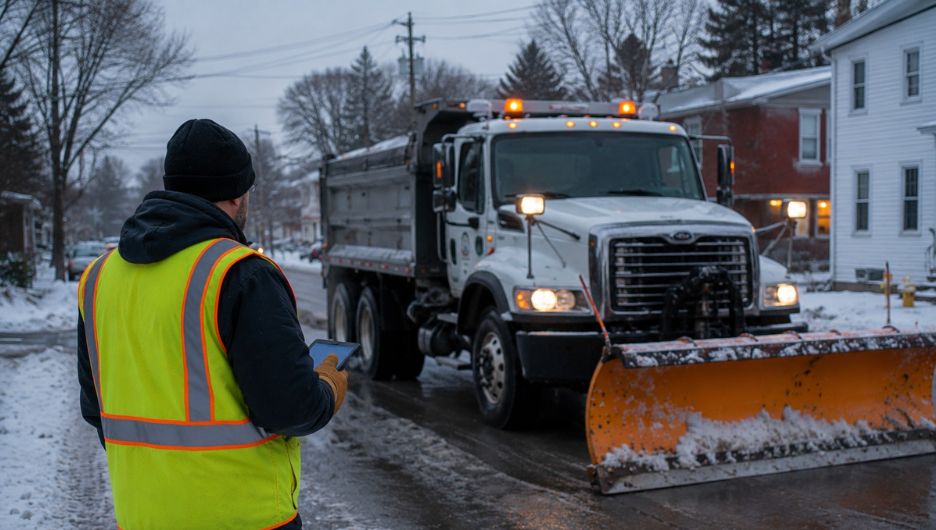
Winter operations are among the most demanding responsibilities a public works department carries. A single storm means clearing hundreds of lane miles across priority routes, residential streets, and emergency corridors, often with the same fleet and crews running extended shifts around the clock. The people who run these operations know the work intimately. What has always been harder is seeing, with certainty and in the moment, what the fleet has cleared while the storm is still underway.
That is the gap that defines a winter program: the distance between what is happening on the road and what a supervisor can confirm from the dispatch office. Radio check-ins and experienced crews carry a department a long way, but they cannot establish with certainty which streets have been cleared, how many passes a route has had, or where a crew should go next. Snow plow tracking, a key component of the Routeware SmartCity solution, exists to close that gap, and it is increasingly what separates a department managing its winter operation from one reacting to it.
Key Takeaways
- Snow plow tracking gives public works teams a live view of where crews have been and which streets have been cleared during a storm.
- Because snow is cleared road by road, with most roads needing several passes, knowing a truck’s location alone is not enough; what matters is knowing the work is done.
- Real-time tracking improves decisions during a storm and provides the record needed to answer residents and elected officials afterward.
- The strongest winter programs use that record to manage operations as they unfold and to plan better season after season.
What Snow Plow Tracking Shows You During a Storm
At its simplest, tracking software reports vehicle location, what roads have been plowed, how many passes each has had, how recently each was treated, and the live status of every crew on shift. What makes tracking valuable is not just location. It shows the work itself: proof of which roads have been cleared, how thoroughly, and how recently.
That distinction is the whole point. Snow is cleared road by road, and many roads need several passes before they count as done, so knowing that a truck drove down a street is not the same as knowing the street is clear. Showing the work, rather than just the vehicle, answers the question that matters most to residents and emergency services alike: which roads are passable right now, and which still need attention.
The most useful thing a team can see is how recently each street was cleared. When a supervisor can tell at a glance which roads were treated within the hour and which have not been touched since the storm began, attention goes where it is genuinely overdue rather than where it is assumed to be needed. Priority corridors stop slipping while focus is elsewhere, and the team works from a current picture of the whole road network instead of memory of what was done an hour ago.
The Cost of Not Knowing Which Streets Are Clear
When a supervisor cannot confirm which streets are clear, every decision downstream is weaker for it. Crews get routed to roads already cleared while others sit untouched. A priority corridor slips because no one registered that it had not been passed since the snow intensified. A service complaint comes down to a driver’s recollection against a resident’s, with no record to settle it. And a query from a city manager or elected official is met with an estimate rather than an account.
None of this reflects a failure of effort or skill. It is the predictable result of running a complex, high-stakes operation without being able to see it clearly. The cost is real and measurable: wasted miles, missed streets, overtime spent covering ground twice, and the slower erosion of public confidence that follows every question a department cannot answer with certainty.
How Municipal Teams Use Tracking During a Storm
With tracking in place, the storm looks different from the dispatch office. A supervisor watches the work happen rather than fielding a stream of radio updates. Every crew’s location, every road cleared, and every gap in coverage updates continuously, so problems show up as they form, not hours later when a complaint arrives.
That changes the calls a team can make. When a crew finishes a route, a supervisor can send them to a sector falling behind instead of waiting for a check-in. As the storm shifts, so can the plan. When wind drives drifts back across a corridor that was already cleared, or one part of the city takes far more snow than forecast, supervisors can redirect crews against what is actually happening on the ground rather than a dated plan drawn up before the first flake fell.
Turn-by-turn guidance also matters most exactly when conditions are worst. When regular drivers cannot get into work and routes have to be covered by less experienced or drafted-in crews, in-cab navigation empowers drivers to run routes they have never driven, guiding them through the sequence, back on track after salt pickups and refueling.. It shortens how long it takes to get onboard a newer driver, which is no small thing in the middle of a storm.
The same record carries weight once the storm passes. When a resident or a member of city leadership asks whether a street was cleared, the department answers from a timestamped record of which roads were treated, when, and how often, rather than from memory. The director walks into a leadership briefing with a clear account instead of radio logs and best guesses.
Kansas City, Missouri shows what this looks like at scale. The city runs 300 snow vehicles, each operator working from a tablet that guides them through their route, confirms priority streets, and flags obstacles. By making crews aware of which areas had and had not been plowed, the city cut mileage by 3% through less route overlap and reduced idle time by 12% year over year. In 2023, the American Public Works Association recognized the city’s approach with its Excellence in Snow and Ice Control Award.
What Snow Demands That General Tracking Misses
Not every tracking tool is suited to snow, and the difference comes down to whether it reflects how winter work actually happens. The most important quality is that it tracks the road network segment by segment, not just the vehicle, because snow is cleared in segments and many roads need more than one pass. A tool that shows where a truck went without confirming what was cleared misses the point entirely.
The information also has to arrive in real time, while a decision can still be changed, rather than in a report compiled after the storm. Winter fleets swell with seasonal and hired vehicles, so the ability to run on standard tablets a team already owns, rather than fixed hardware, makes it practical to equip the whole fleet each season. And winter does not stand alone; the strongest results come when snow sits within the same operational view a department uses for its other services, rather than as a separate seasonal silo. Cities weighing this closely will find it worth understanding what cities really need from snow removal software before settling on an approach.
That connection extends beyond the fleet. When snow operations link to a city’s wider systems, including emergency services or 311 service requests, a resident’s report of an impassable street can flow directly to the crews working that area, and the response can be integrated into broader storm response operations.. Snow operations run as part of the city, not apart from it.
Running a Smarter Winter Program
The departments running the strongest winter operations are not those with the largest fleets. They are the ones that have given their teams a clear, real-time view of the work and a record to account for it afterward. That turns a service long dependent on experience and radio calls into one managed with the same confidence as any other core operation.
A smarter winter program is less about any single storm than about how a department carries its knowledge from one season to the next. When every event produces a clear record of what was done and where effort was concentrated, planning improves, briefings get easier, and the operation grows steadily more efficient over time. The point is not to replace the judgment of experienced crews and supervisors, but to give that judgment better information to act on.
For public works leaders, the value is practical and cumulative: better decisions during the storm, stronger answers after it, and a more defensible operation season after season. A department that can see its winter work as it happens stops managing by estimate and starts managing by record. To see how segment-level snow plow tracking works in practice, explore Routeware SmartCity snow solutions or book a demo.
Frequently Asked Questions
Snow plow tracking gives public works teams a real-time view of their winter operation, showing where crews have been, which streets have been cleared, how many passes each has had, and how recently. It replaces radio check-ins and memory with a live, verifiable picture of the work.
It works by reporting each vehicle’s location and activity continuously to a view that supervisors monitor during a storm. It records clearing at the road-segment level, so a team sees not just where crews are, but which roads have been plowed or treated, updated live as conditions change.
A team can see crew location, route progress, which roads have been cleared, the number of passes each has had, how long since each was last treated, and crew status. Together these show the real-time condition of the road network, not just the position of the fleet.
Municipalities use it to monitor coverage live during a storm, redeploy crews that have finished their routes to areas falling behind, prioritize roads overdue for treatment, and answer resident and city leadership enquiries from a verifiable record rather than radio logs.
About the Author

Katie Kinnear
Katie Kinnear is Director of Brand Strategy at Routeware, where she leads brand, messaging, events, and communications efforts across the company’s full product suite. A 2024 Waste360 40 Under 40 honoree, she is passionate about advancing meaningful dialogue around circular solutions, smart city technology, and the future of waste and recycling. Katie serves on the boards of the Utah Recycling Alliance and Recycle Utah, extending her commitment to sustainability beyond the workplace and into her community.
 North America
  United Kingdom