Blog
Waste Management Software: Buyer’s Guide for Waste Haulers
by Joel Scott • June 18, 2026
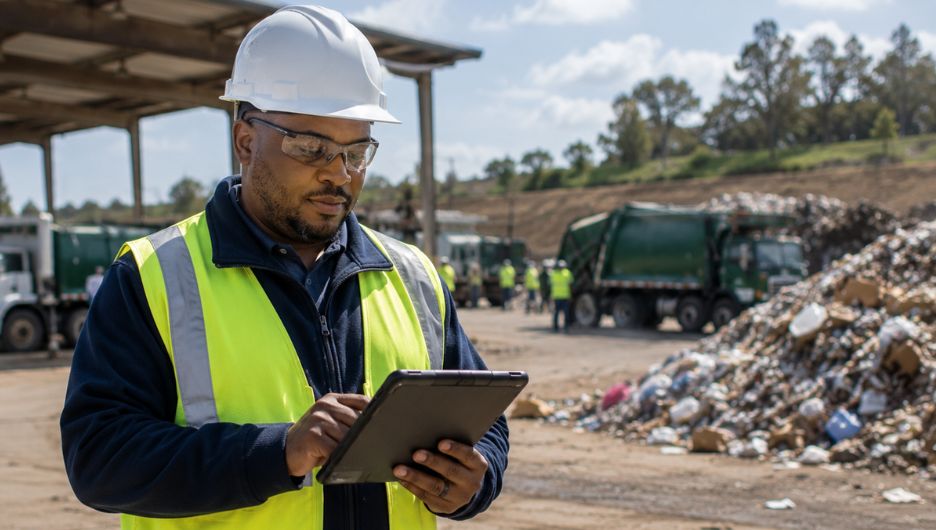
In most waste and recycling operations, the working day still revolves around paper, spreadsheets and the phone. Drivers collect printed route sheets each morning, dispatchers juggle requests across phone and radio, and back-office staff key service records into one system while billing runs in another. None of it is unusual, and it hasn’t always seemed like a problem. The work got done.
The difficulty surfaces as the operation changes. Each function runs on its own tool, the tools do not speak to one another, and the gaps between them fill with manual effort, lost paperwork, and disputes that take hours to resolve. The service performed in the field and the invoice sent at month end is maintained separately and reconciling them becomes a job in itself. This is the problem modern waste management software is built to solve, by replacing a patchwork of disconnected tools with connected platforms.
Key Takeaways
- Waste management software is the platform a hauler uses to run collection, customer service, billing, and compliance on one connected system.
- The central benefit is connection: when routing, service, and billing share one record, work is captured accurately and revenue stops leaking at the seams.
- A connected platform lowers operating cost, improves service, reduces risk, and makes growth and acquisitions easier to absorb.
- Software built for waste fits the realities of collection in a way that general-purpose tools adapted from other industries do not.
Waste Management Software: One Tool, From the Truck to the Invoice
Every collection has a journey that does not end when the truck pulls away. The stop has to be recorded, the service logged against the right account, any extra charge captured, and the whole thing turned into an invoice that matches what happened. Waste management software is the technology that carries that journey from start to finish: routing and dispatch, in-cab service, customer records, billing, payments, and compliance, all handled in one place.
The distinction that matters is connection. A business can own a routing tool, a billing package, an in-cab system, and a customer portal and still operate in silos, because the tools do not share data. Connected waste management software joins those functions together, so what happens on the truck flows straight into customer records and onto the invoice without rekeying or reconciliation. That is the whole idea behind one tool, from the truck to the invoice: a single record of the operation that every function draws on, instead of a chain of disconnected steps that someone has to stitch together by hand.
Why Waste-Specific Software Matters
Not all software that touches routes and customers is built for waste, and the difference is consequential. Generic field-service or logistics platforms are designed for lighter, simpler work, and they tend to break on the realities of collection: the volume of stops, the varying collection frequencies, the safety and vehicle constraints, the disposal trips, and the mix of residential, commercial, and roll-off service that a single operation runs at once.
Software built specifically for waste and recycling accounts for these realities rather than forcing the operation to work around them. It understands the difference between a residential refuse route and a commercial or roll-off book within the same operation, and it is shaped around how the industry operates. The benefits described above only materialize when the software fits the work, and for waste, that means a platform built for the industry rather than adapted to it.
How to Choose Waste Management Software
When it comes to choosing a solution for your business, a few criteria matter more than the rest
- Built for waste: The platform should be purpose-built for collection work, its stop densities, mixed service types, disposal runs, and safety demands.
- Built to scale: The right system absorbs new routes, customers, and even acquired companies without forcing a fresh implementation each time, so expansion is a manageable step rather than a disruption.
- Seamless Integration: It should connect cleanly with the tools the business already depends on, from accounting and ERP to GIS and telematics, with a clear path for data to move between them.
- Easy to Use: It should be more straightforward for drivers, dispatchers, and office staff than the tools it replaces, intuitive in the cab and at the desk, so the people who run the operation lean on it every day rather than working around it.
The Benefits of the Right Waste Management Software
- Lower operating cost: Optimized routes, balanced workloads, and accurate service data reduce the miles driven, the trucks required, and the overtime worked. Each of those is a direct and recurring saving, and they accrue week after week rather than once.
- Fewer missed pickups: When service is confirmed in the field, often with a timestamped photo, a disputed collection is settled in seconds instead of with a return trip. The operation can show a resident or a customer exactly what happened at their stop, which cuts both cost and complaints.
- Real-time visibility: A connected platform gives operators a real-time view of the operation, every truck, route, and exception, along with the data to make decisions with evidence rather than instinct. Management stops being reactive and starts being informed.
- Accurate billing: When the service record from the field and the billing system use the same data, every chargeable service gets invoiced, overages are not missed, and credits are not issued by mistake. The invoice matches the work that was done, which protects revenue.
- Lower risk: Waste operations have a lot to keep track of and report on, recycling and tonnage numbers, safety checks, vehicle inspections. The right platform records all of it automatically as the work happens, so when a report is due or someone asks for proof, it is already there.
How Casella Waste Systems Absorbs an Acquisition Without Starting Over
Casella Waste Systems, headquartered in Rutland, Vermont, runs collection, transfer, and disposal across the northeastern United States and grows steadily through acquisition. Every company it acquires arrives with its own routes, customers, containers, and service schedules. Folding all of that into one operation, rather than running each acquisition as a separate island of data, is the real test of a waste management platform. On a recent acquisition project the company reduced miles by 21% and cut fuel use by 5,000 gallons a year.
The Hauler Shouldn’t Have to Work Around the Software
The right waste management software is not the one with the longest feature list. It is the one that fits how your operation runs, connects the work your teams already do, and grows with you rather than against you. The aim of a decision like this is not to adopt technology for its own sake, but to replace fragmentation with a consolidated, reliable view of the operation, so the software works for the team rather than the team working around the software.
Frequently Asked Questions
Waste management software is the platform a waste hauler uses to run its collection operation, including routing and dispatch, in-cab technology, customer service, billing and payments, and compliance.
It manages the full operational chain of a waste business: building and optimizing routes, directing crews, confirming service, handling customer enquiries, generating accurate invoices, and supporting compliance reporting.
Private waste haulers use waste management software to run collection, dispatch, billing, and customer service from one connected system, from large regional operators to independent haulers managing a single market.
A connected platform lowers operating cost, reduces go-backs and complaints, captures revenue that would otherwise leak between systems, improves real-time visibility, simplifies compliance, and makes growth and acquisition integration far easier to manage.
About the Author

Joel Scott
Joel Scott leads product marketing at Routeware. With more than two decades of experience in enterprise software for the public and private sectors across the UK and North America, Joel writes on the critical operational and technology challenges facing governments and resource management companies today.
 North America
  United Kingdom