Blog
How to Run Street Sweeping Operations Efficiently
by Katie Kinnear • June 17, 2026
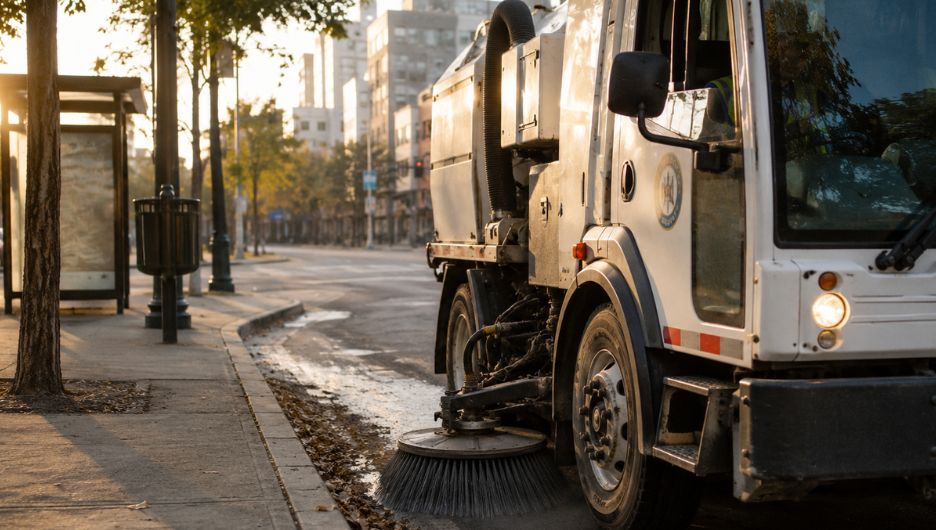
Street sweeping operations is not the first responsibility that comes to mind when one thinks of public works responsibilities Keeping streets clean is not “mission critical” in the same way waste collection or snow operations might be; but when the streets are neglected people notice. Alternatively, when they are proactively swept, clean streets become a source of civic pride and a strong reflection of a high performing public works team.
Most sweeper programs are run on a combination of driver experience, paper manifests, and end-of-day radio check-ins. That system works when fleets are small and supervisors know every driver personally. This method becomes a liability when routes scale across dozens of vehicles covering tens of thousands of curb miles. If a street is missed routinely or even just once, eventually resident complaints or photos are escalated directly to elected officials and resident satisfaction surveys quickly start to trend down.
Key Takeaways
- Street sweeping operations running on paper manifests and radio check-ins have no reliable way to audit segment coverage, measure driver productivity accurately, or respond to resident complaints with evidence.
- Segment-based tracking, automatic pass confirmation, and in-cab navigation are the operational changes that convert a reactive sweeper program into one that can be actively managed and improved.
- The City of El Paso increased driver productivity by 28% and cut new driver onboarding from two to three months down to three weeks, without adding trucks or changing driver hours. The $85,170 in annual savings came from the same fleet, running better data.
- Street sweeping software that requires months of hardware procurement and a complex implementation rarely survives contact with a public works department running live operations. Routeware SmartCity deploys in under 90 days on devices the fleet already carries.
Why Street Sweeping Operations Are Harder to Manage
Unlike solid waste collection, where a missed bin generates a complaint the same day, street sweeping runs on much longer cycles. A single full pass across a city’s street network can take weeks or months, which means coverage gaps do not surface quickly. By the time a supervisor identifies that a set of segments has been skipped or swept out of sequence, the inefficiency has already compounded: fuel spent on redundant passes, overtime spent on revisiting routes, and resident complaints for which the operations team has no data to lean on.
The 3 operational problems that surface most consistently in sweeper programs are:
- No real-time location or pass confirmation during the collection day: Supervisors rely on radio check-ins and post-route reports rather than live data. If a driver falls behind, completes a segment out of sequence, or misses a pass entirely, the gap is often not identified until a complaint comes in or a supervisor physically checks the route.
- Segment coverage that cannot be audited: Paper manifests record which routes were assigned, not which street segments were serviced. When a resident or council member asks whether a particular block was swept in the last 30 days, most operations teams cannot answer that question with confidence.
- Driver onboarding that consumes months of operational capacity: Experienced sweeper operators carry institutional knowledge about route nuances, parking patterns, and segment sequences that is rarely documented. When drivers leave, that knowledge leaves with them. New operators typically spend 2 to 3 months learning routes to a standard where they can work independently.
Each of these problems compounds the others. Without real-time visibility, supervisors cannot intervene early. Without auditable coverage data, productivity cannot be measured accurately. Without faster onboarding, turnover creates coverage gaps that are difficult to close.
What Efficient Street Sweeping Operations Look Like
The key to more efficient sweeper operations is not working drivers harder. It is about giving operations teams the data they need to identify where capacity is being lost and make targeted adjustments.
Segment-Based Tracking: Route-level reporting tells you whether a route finished. Segment-based tracking tells you which streets were serviced, how many passes were completed, and at what time. That distinction matters for programs where multi-pass requirements vary by street type, where salt trucks and plow trucks require different pass counts, or where one driver needs to pick up where another left off.
When coverage data is captured at the segment level, supervisors can answer coverage questions in seconds rather than reviewing paper manifests or contacting drivers directly. That capability changes how complaints are handled. Instead of investigating whether a street was swept, an operations coordinator can pull the data and respond to a 311 call with specific information about when the segment was last serviced.
Pass Confirmation: In-cab technology designed for sweeper operations should automatically capture service confirmations as the vehicle moves through a segment at an operational speed, without requiring the driver to manually log each pass. That approach reduces the cognitive load on drivers, enabling them to focus on safe driving, and ensures that the data reflected in back-office systems matches what happened in the field, not just what was logged.
Automatic service verification also supports exception handling. When a driver encounters a blocked segment, a parked vehicle obstructing access, or a road closure, the exception can be flagged and photographed directly from the cab. That photographic record becomes the evidence for responding to resident complaints and for adjusting route sequences in subsequent passes.
Routes Without Specialists: Rebalancing a sweeper route has traditionally required either a GIS consultant or days of spreadsheet work. Holiday schedule adjustments, new street additions, a vehicle breakdown mid-route, a driver who calls in sick with four hours of segments still to be covered. Each is a common operational event. Without the right tools, each one demands manual intervention that takes time the operations team does not have. With the help of routing software, operations team can handle a range of events with speed and precision.
How Routeware SmartCity Is Built for Street Sweeping Operations
SmartCity is Routeware’s street sweeping software for municipal fleet operations. It tracks operations at the segment level rather than the route level. As a sweeper moves through a street at operational speed, the system confirms the pass automatically without driver input. Segments are colour-coded by time since last service: green for under four hours, yellow for four to eight, orange for eight to sixteen, purple for sixteen to twenty-four, and red for anything beyond that. Supervisors can see the real-time coverage status of every street in the city at a glance, without contacting drivers or reviewing paper records.
Multi-pass requirements are configurable per street type. A one-way residential street and a multi-lane downtown arterial carry different pass count. The system marks a segment complete only when the configured number of passes has been confirmed, so partial coverage is always visible and never mistaken for a completed route.
When a driver encounters a blocked segment, a parked vehicle obstructing access, or debris that requires flagging, the exception is logged with a photo directly from the cab. That record gives supervisors the evidence to respond to resident complaints without investigation, and gives operations teams the data to adjust sequences on the next pass.
Water and material ticket capture is handled digitally through the driver app, replacing paper logs at disposal and refill points. Pre- and post-trip vehicle inspections are completed in-cab with mandatory checklist items and photo capture, generating a maintenance record that travels with the vehicle rather than sitting in a filing cabinet at the yard.
Learn more about Routeware’s street sweeping software solutions and how SmartCity Sweeper is deployed for municipal sweeper programs.
How El Paso Sweeps 35,000 Curb Miles and Saves $85,170 a Year
The City of El Paso deployed Routeware SmartCity Sweeper across 10 street sweepers covering 35,000 curb miles, including residential streets, medians, bike lanes, and downtown corridors. Before SmartCity, supervisors had no way to know which segments had been swept or when. Driver onboarding took two to three months. Go-back decisions were made without coverage data.
After deployment, driver productivity increased 28%, from 96 to 122 passes per route. Route mileage dropped 8%. New drivers reached operational standard in approximately three weeks. The city saved $85,170 annually and reduced fuel consumption by 4,173 gallons. When a resident called about a street that had not been swept, coordinators could pull the segment history and respond immediately rather than investigate.
From Finishing Routes to Knowing What Happened on Every Street
Most sweeper programs are not failing because of effort or headcount. They are running the same routes, with the same drivers, on the same schedule they have followed for years. The problem is not operational capacity. It is operational visibility. Without segment-level data, a supervisor cannot tell whether a street was swept twice this week or not at all. Without pass confirmation, a route marked complete on paper may have left gaps that will not surface until a resident call. Without exception records, a blocked segment gets re-attempted by default because there is no other basis for the decision.
Moreover, the value of a data-driven sweeper program is not mere reporting. It is in the real-time capture and analysis of that data: what the team can see during the collection day, what it can prove when a complaint comes in, and what it can act on before a small coverage gap becomes a pattern that takes weeks to identify and correct.
That knowledge is what separates a sweeper fleet that simply finishes its routes from one that can tell you, at any point in the day, which streets have been covered, which have not, and why. The difference between those two programs is not resources. It is data.
Frequently Asked Questions
Coverage accountability. Without segment-level tracking, there is no reliable way to confirm whether a specific street was swept, how many passes were completed, or which side of a divided road was serviced. That gap surfaces the moment a resident or council member asks a question that paper records cannot answer.
By removing manual logging from the driver’s workload. Automatic service confirmation registers a segment as the vehicle passes through it at operational speed, without driver input. Drivers interact only when something prevents collection, which keeps them moving and produces a more accurate coverage record than manually logged entries.
Yes, through two mechanisms: better route sequencing reduces total miles driven, and segment-level pass tracking eliminates redundant passes on already-serviced streets. Both improvements compound across fleets running multi-week sweeping cycles, where small per-shift reductions accumulate into material annual savings.
GPS tracking shows where a vehicle travelled. Segment tracking records which streets were serviced, how many passes were completed, and whether multi-pass requirements were met on each street type. For programs running on multi-week cycles, only segment data can answer specific coverage questions with confidence.
Segment-level pass tracking, automatic service confirmation without driver input, configurable multi-pass requirements per street type, exception logging with photo capture, and GIS integration. Implementation timeline and hardware requirements matter as much as features: software that requires proprietary hardware or places the implementation burden on the operations team creates avoidable adoption risk.
Street sweeping software that requires months of hardware procurement and a complex implementation rarely suits a public works department running live operations. Routeware SmartCity deploys in under 90 days on devices the fleet already carries so the operations team stays focused on collection.
About the Author

Katie Kinnear
Katie Kinnear is Director of Brand Strategy at Routeware, where she leads brand, messaging, events, and communications efforts across the company’s full product suite. A 2024 Waste360 40 Under 40 honoree, she is passionate about advancing meaningful dialogue around circular solutions, smart city technology, and the future of waste and recycling. Katie serves on the boards of the Utah Recycling Alliance and Recycle Utah, extending her commitment to sustainability beyond the workplace and into her community.
 North America
  United Kingdom