Blog
What Every Solid Waste Operations Manager Needs to Know About Solid Waste Management Software
by Katie Kinnear • July 20, 2026
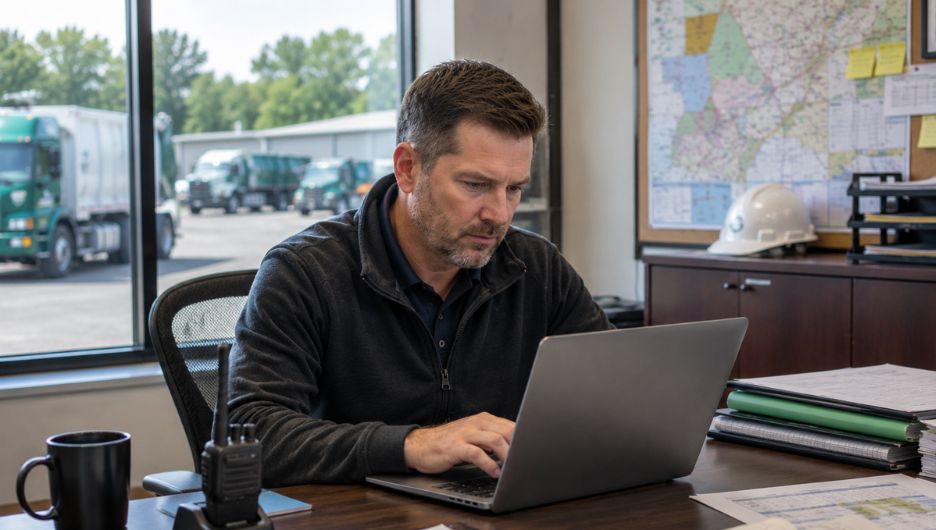
A Solid Waste Operations Manager with 15 years on the job knows exactly where their collection program is leaking. Which routes run long. Which trucks are faulty. Which stops will generate a call before the truck gets back to the yard. What they rarely have is the data to act on that knowledge in real time, or to prove what happened at a specific address when a dispute lands on their desk.
That is the gap solid waste management software is supposed to close. Whether it does depends almost entirely on one question: does it hold up in the field, under the conditions your drivers and dispatchers actually work in? Not just under the controlled conditions of a vendor demo?
The concerns that surface most consistently when an operations team evaluates a new platform are not about features. They want to know: Will it survive and perform accurately over each and every mile travelled by a heavy truck? Will drivers with 15 years on a route use it (and recommend it to other drivers)? Will it reduce go-backs or just add another layer of reporting? Will it handle the complexity of routes that no generic logistics tool has ever managed successfully?
These top concerns are worth addressing directly as they determine whether the technology investment delivers measurable operational change or becomes another system the team works around.
Key Takeaways
- Driver adoption fails when software adds work. It succeeds when drivers need only interact with the system when something goes wrong. Geofence-based automatic confirmation handles normal stops without any input from the driver.
- Most go-backs are unnecessary. The only reason they happen is that without proof of service, there is no other defensible response. Photographic exception logging changes that default response and provides accountability.
- Routes that seem too complex for software are usually the routes that need it most. Breakdowns, callouts, and schedule changes are not edge cases. They are the daily conditions purpose-built solid waste platforms are designed to handle.
- The City of Denton, Texas turned 120,000 weekly stops, 78 vehicles, and a paper-based operation into $286,000 in identified annual savings. Go-backs dropped 70%. Route mileage fell by 39 miles across 65 residential routes. 75,000 pieces of paper eliminated annually by implementing Routeware.
Why Driver Adoption Is Not the Risk You Think It Is
Experienced drivers do not resist technology for spite. They are wary because they have seen systems that created more work than they solved. An experienced driver has developed a rhythm that works. Asking that driver to log into a tablet at every stop and manually confirm service is asking them to do more work, not less. Such a “solution” fails in the field within weeks.
The design principle that separates platforms that stick from those that sink is interaction only for exceptions. On a normal stop, the driver does nothing. Geofence-based automatic service confirmation registers the collection as the vehicle passes through the designated zone at operational speed. The system records the stop. The driver drives.
The driver only engages the tech when something is wrong: a cart not out, a blocked access point, a contaminated bin. They flag the exception, take a photo, and move on. That is a fundamentally different ask than manual logging at every stop. Drivers who felt surveilled by previous systems often come to regard this approach differently once they understand that the photo evidence works in their favour as much as it serves the supervisor. The exception record is not punitive. It is the evidence that resolves a dispute without a phone call, a go-back, or a supervisor having to take a driver’s word against a resident’s.
That shift in design is why driver adoption succeeds or fails. Successful technology respects the rhythm of a working collection day.
Go-Backs Are a Data Problem, Not a Routing Problem
Go-backs are expensive in ways that are straightforward to calculate: fuel, driver time, vehicle wear, the cost of a second trip. What is harder to quantify, because it requires data that most operations teams do not have, is how many of them were unnecessary.
Without service verification, the default response to a missed pickup complaint is to send the driver back. There is no other defensible option. The operations team cannot prove the driver was there, cannot confirm whether the bin was out at collection time, and cannot ask a resident to accept a ‘we checked and it was serviced’ response without evidence to back it up. So the truck goes back.
The data from municipalities that have implemented service verification consistently shows the same pattern: the majority of reported missed pickups are not missed pickups. Bins were not out at collection time, access was blocked, or the collection was completed but not in the window the resident expected. When that evidence exists at the stop level, the go-back decision changes from a default to a judgment call made on actual information. That shift reduces customer service call volume significantly and provides accountability.
Route Complexity Is the Reason to Use This, Not the Reason to Avoid It
The objection that a city’s routes are too complex typically comes from operations managers who have seen generic logistics tools fail in a waste collection environment. Those tools were not built for the exceptions, the service type combinations, and the operational variability that defines a working collection day. The failure of some platforms is not evidence that the right platform cannot handle complexity.
Solid waste collection routes are not inherently complex. They are complex because the conditions under which they run change daily. A breakdown, a callout, a schedule change, a new development added to an already full route. Each one requires a decision, and in a program without the right tools, each decision requires manual intervention that pulls supervisors away from everything else they are managing.
Purpose-built platforms handle these as operational realities, not as unsolvable exceptions. When a vehicle breaks down mid-route, a nearby driver can access all remaining stops immediately and pick up where the previous driver left off, without dispatcher intervention and without significant wait time. Holiday schedule adjustments and expanded collection offerings are managed through route planning tools that let operations managers model changes without touching live data. Route rebalancing that previously required a GIS consultant or days of spreadsheet work is handled by the operations team.
The routes that seem too complex are usually the routes that need tech support the most.
What Solid Waste Management Software Needs to Survive a Real Collection Day
Solid waste operations managers do not evaluate platforms the way procurement officers do. The feature list matters less than whether the tech will make a collection day easier for drivers, supervisors and back office staff. The challenges are consistent across most municipal programs: no visibility until drivers return to the yard, go-back decisions made without evidence, routes that take weeks to rebalance, and new drivers who take months to reach full productivity. Tech success is proven in the field, not through an RFP checklist.
| Operational Challenge for Solid Waste Operations Managers | How Solid Waste Management Software Resolves It |
|---|---|
| No real-time visibility into truck location or route progress during the collection day | Live dispatch dashboard shows every vehicle, every route, and every exception as they happen |
| Go-back decisions made by default because there is no proof of what happened at a stop | Automatic service confirmation and photographic exception logging create a timestamped record at every address |
| Disputed missed pickups resolved by gut feel rather than evidence | Stop-level service records and exception photos allow customer service teams to respond in seconds rather than investigate |
| Route rebalancing requires a GIS consultant or days of manual spreadsheet work | Route planning tools let operations managers model and rebalance routes directly without specialist involvement |
| A vehicle breakdown mid-route leaves stops uncovered until manual reassignment is complete | Nearby drivers can access remaining stops immediately and continue the route without dispatcher intervention |
| New drivers take months to learn routes independently | In-cab turn-by-turn navigation and digital route guidance reduce the time to full productivity significantly |
| Multiple service types running simultaneously create coordination complexity | Vehicle-type-specific workflows handle residential, commercial, recycling, bulk, and organics within a single platform |
| Performance reporting requires manual compilation from paper records | Route-by-route metrics available on demand without manual data extraction |
How the City of Denton, Texas Transformed Its Solid Waste Operations
Denton’s Solid Waste and Recycling Department operated 78 vehicles across 240 weekly routes, servicing 120,000 stops every week. That entire operation ran on printed route sheets. Supervisors tracked progress through paper reports compiled at the end of each shift. When a resident called about a missed pickup, there was no way to verify what had happened at that address without reaching the driver directly. Go-backs were issued by default. Route imbalances accumulated silently because the data to identify them did not exist.
The City of Denton, Texas deployed Routeware SmartCity across its fleet and digitized its entire solid waste operation. Drivers logged issues in real time. Supervisors gained a live view of every vehicle and every route. Customer service teams could pull a stop record in seconds rather than tracking down a driver.
Within two years, unnecessary go-backs had dropped by 70%. Route mileage fell by 39 miles on average across 65 residential routes. The City eliminated 75,000 pieces of paper annually. Over $286,000 in identified annual savings followed, not from adding resources, but from finally being able to see where they were being lost.
The Operations Team Deserves Better Than End-of-Day Guesswork
No operations manager likes surprises. And yet their day is almost predictably full of them.
The missed pickup that nobody can verify. The go-back that should never have happened. The route that finished two hours late. These are not failures of effort. They are failures of visibility, and they repeat themselves every collection day until the data infrastructure changes.
Routeware SmartCity is built for exactly this operational reality. It gives dispatchers a live view of every vehicle and every route during the collection day. It gives drivers in-cab tools that confirm service automatically and log exceptions with photo evidence without interrupting the collection rhythm. It gives operations managers the route management tools to handle breakdowns, callouts, and schedule changes without escalating to a specialist or rebuilding from paper. And it gives the entire team, from the driver to the Public Works Director, a single source of truth about what happened on any given route on any given day.
Solid waste management software does not change the work. The trucks run the same streets. The drivers follow the same sequences. What it changes is what the operations team knows while the collection day is still happening, and what it can action when something goes wrong. That difference, between running routes and knowing what happened on them, is where the value of the right software lives.
Frequently Asked Questions
Routes degrade as collection territories are added and collection patterns shift without corresponding route updates. Without performance data at the route level, those inefficiencies are invisible until they compound into higher fuel costs, inconsistent finish times, and complaints clustering on specific routes.
The system registers a stop as the vehicle passes through a geofenced zone at operational speed, without any driver input. The driver only interacts when something prevents collection. That keeps drivers focused on the road and produces a more accurate service record than manual logging.
Trip times, stop counts, miles driven per shift, and stop-level service records. Without those figures, rebalancing is guesswork. With them, operations managers can identify which routes are overloaded and where consolidation is possible without reducing service levels.
A nearby driver can access the remaining stops immediately and continue from where the breakdown occurred, without dispatcher intervention or a new paper manifest. The route exists digitally and is accessible to any authorised driver in real time, so coverage is maintained without manual reassignment.
Routeware SmartCity replaces paper manifests and radio check-ins with a live digital operation. Dispatchers see every vehicle in real time. Drivers confirm service automatically and log exceptions with photo evidence. Route changes and breakdowns are handled by the operations team directly, without specialist involvement.
About the Author

Katie Kinnear
Katie Kinnear is Director of Brand Strategy at Routeware, where she leads brand, messaging, events, and communications efforts across the company’s full product suite. A 2024 Waste360 40 Under 40 honoree, she is passionate about advancing meaningful dialogue around circular solutions, smart city technology, and the future of waste and recycling. Katie serves on the boards of the Utah Recycling Alliance and Recycle Utah, extending her commitment to sustainability beyond the workplace and into her community.
 North America
  United Kingdom