Customer Story
How Hampton Roads Planning District Commission Serves 17 Communities with One Waste Wizard
THE CHALLENGE
Shared Recycling Goals Across a Diversity of Communities
Hampton Roads Planning District Commission is no stranger to operational complexity. The HRPDC team — a small staff led by Katie Cullipher and Rebekah Eastep — is tasked with environmental education and public outreach across 17 jurisdictions, but the Commission itself doesn’t manage a single curbside route. Solid waste and recycling contracts are negotiated locally, programs are administered locally, and even communities served by the same hauler may accept different materials under different terms.
Layered on top of that, two regional service authorities — the Southeastern Public Service Authority on the southside and the Virginia Peninsula Public Service Authority to the north — coordinate parts of the program for some jurisdictions but not all. Some cities run their own fleets and haul to the MRF (Portsmouth and Hampton, for example); others contract the hauling out entirely. As Cullipher put it, “It is a mixed bag.”
The result was a regional education problem that no single piece of artwork or PDF could solve. Before implementing ReCollect, the HRPDC team published recycling guidance the only way they could: a mix of web pages and PDFs, customized per community, hard-coded into the website.
HAMPTON ROADS PLANNING DISTRICT BY THE NUMBERS
“It was very labor-intensive, and anytime there was a change, there was artwork that had to be updated, and webpages that had to be updated.”
Due to this complexity, regionwide education campaigns were limited to broad categories like “cans” or “plastic bottles.” Residents who needed real, locality-specific guidance had to research further, and contamination — a national issue that’s especially costly for coastal MRFs — was getting worse, not better. Compounding the pressure, several local recycling contracts had shifted or been terminated in recent years, meaning the rules residents thought they knew were changing underneath them.
For smaller jurisdictions like Gloucester, Poquoson, or even Portsmouth, the impetus to license a modern resident-facing recycling tool independently simply wasn’t there.
THE OPPORTUNITY
A Single Source of Truth, Customizable by Location
In June 2024, HRPDC received grant funding from the Environmental Protection Agency (EPA) for Recycling Education and Outreach (REO) allowing them to enhance the regional contamination-reduction and education campaign, Start Smart, Recycle Right Hampton Roads. This funding allowed the team to pursue a digital backbone that could do something unusual: speak with one regional voice while still giving every resident answers tailored to the specific city or county they live in.
A handful of HRPDC member communities — Norfolk among them — were already using ReCollect’s Waste Wizard and reported strong results. That proven track record made the choice straightforward, and ReCollect’s multi-community architecture was uniquely suited to the hub-and-spoke model HRPDC needed:
- A single Waste Wizard, 17 community filters. Residents can use one tool and get answers calibrated to their specific jurisdiction’s hauler, contract, and accepted materials.
- Embeddable, locality-defaulted tools. When the City of Suffolk asked for a version of the tool that pre-filtered so Suffolk residents wouldn’t have to navigate through 16 other communities to find their answer, Routeware built the functionality. Hampton, Suffolk, and others have since embedded the tool directly into their own municipal websites thanks to this customized capability.
- Detailed, item-level guidance. Instead of “cans,” the tool can now tell residents to take the lid off, rinse it, make sure it’s empty — the kind of detail Rebekah Eastep noted “we could never have gotten into beforehand.”
- Built-in engagement. The Waste Sorting Game gives HRPDC another channel to reach audiences who don’t read flyers, and seasonal customization lets the team push Christmas tree disposal info in January and yard-waste guidance in fall.
- Analytics that close the loop. Search-term data shows the team what residents are confused about and when — surfacing, for instance, that confusion around bagged recyclables and TVs is widespread, and giving HRPDC and its localities the data to retarget education accordingly.
Crucially, by purchasing regionally, HRPDC unlocked economies of scale that no single member jurisdiction could have justified on its own.
“Several of our communities probably wouldn’t have the budget to do this on their own — but because we’re doing it regionally, there are some economies of scale built into that, and so they do get access to this tool.”
THE RESULTS
A Foundation for Education and Regional Collaboration
Two years in, ReCollect has moved from a useful add-on to the centerpiece of HRPDC’s regional public-outreach strategy. As the team prepares to launch its full-scale public campaign — built around the message “Don’t guess, just ask” — the multi-community Waste Wizard is the place every flyer, social ad, news release, and convenience-center sign points back to.
“Our regional campaign is kind of built around it, to be honest…We knew it was going to be important, but things have changed so much with our local recycling programs that it’s become more of this cornerstone to our public education efforts than even before.”
A unified front door for a fragmented region.
Residents now have one place to go for accurate, locality-specific recycling and disposal guidance, even though the underlying programs differ significantly across the 17 jurisdictions. HRPDC can run regional messaging and still deliver hyper-local answers — the goal that was previously impossible to reach with hand-built PDFs.
Dramatically less manual work.
Updates that previously required reworking artwork and rebuilding web pages now happen through a single change in the platform. As Cullipher described it: “Rebekah can go in and make one change in the system, and it can be updated across the board, and we don’t have to do all that custom implementation.
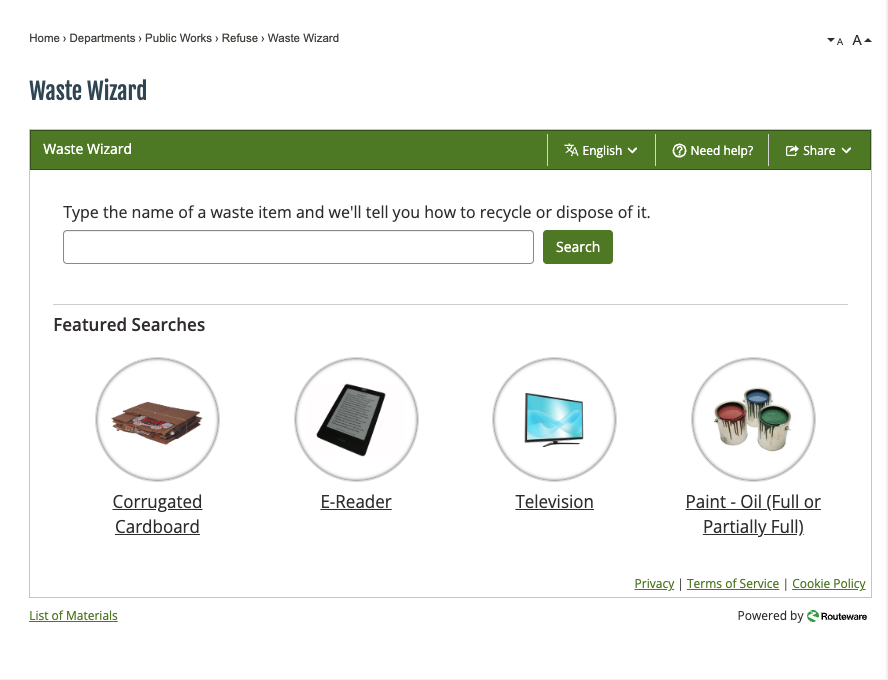
Real, measurable behavior change at the community level. In Suffolk — one of HRPDC’s earliest adopters of the embedded, locality-filtered tool — Daniel McDonald, who staffs the Suffolk Clean Community Commission, reports a noticeable drop in repeat resident inquiries since the Waste Wizard went live on the city’s site:
“I can’t think of any multi-time callers anymore — I used to have my frequent flyers, and I don’t have them anymore.”
McDonald also uses the search analytics to direct his own education priorities — “it gives us insight into what people don’t know and what they want to know” — and notes that residents consistently land on the tool through its embed on the city site without him having to shepherd them there.
Smarter, data-informed regional messaging.
Search analytics let the HRPDC team see usage spikes line up with their social and earned-media pushes, and the data shapes what they emphasize next. Combined with the Commission’s Feet on the Street curbside contamination program, the analytics are giving the team a clearer picture of where to focus regional messaging — like the unexpectedly high incidence of bagged recyclables they discovered in resident bins.
A model for regional collaboration.
Beyond the recycling outcomes themselves, the deployment has become a tangible proof point of regional cooperation that HRPDC can point to in grant reporting and stakeholder communications — one more concrete way the 17 communities of Hampton Roads are working together.
“Recycling messaging has always been a challenge for us… how do you do that regionally when the contracts are managed locally? This tool helps us put out messaging that fits everyone; but then bring them back to one place to find the really local information that’s important to people at the end of the day.”