Customer Story
East Hants Slashes Hotline Calls 84% with Routeware ReCollect
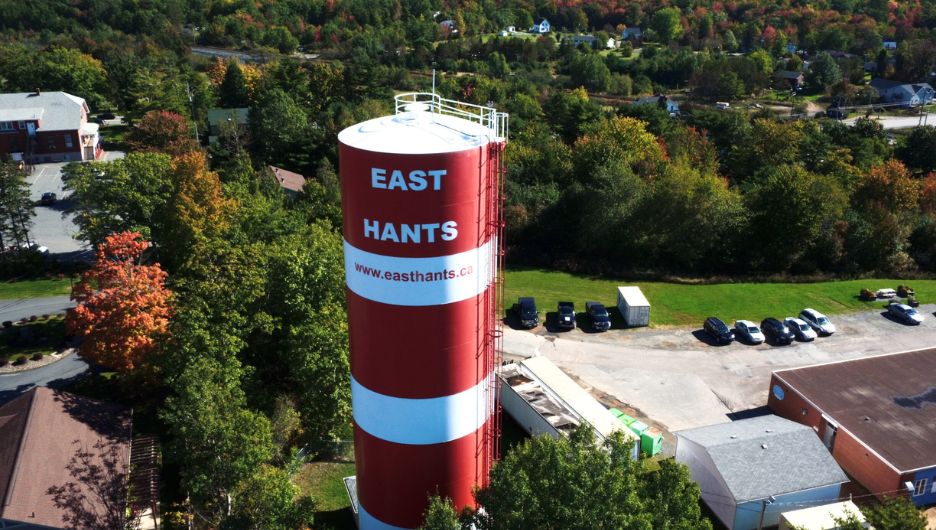
Ten years in: how a 26,000-resident Nova Scotia municipality cut hotline calls by 84% — and made ReCollect its trusted tool for managing evolving EPR commitments.
The Challenge
East Hants doesn’t look like the typical “small municipality” customer. Nova Scotia has had landfill-ban regulations on the books since 1996 — so with 30 years of mandatory diversion, with dozens of items that legally cannot go to landfill — and a layered set of Extended Producer Responsibility (EPR) programs covering electronics, tires, batteries, and, now packaging since December 2025. For East Hants residents, sorting is not simply a “nice to do” – it’s the law.
That regulatory weight created a communications problem that was much bigger than East Hants’ headcount. Before adopting Routeware ReCollect, the team relied on what every small municipality relies on: an annual print calendar and newsletter mailed once a year, radio updates (if their messages weren’t buried by larger municipalities), a hotline for questions, in-person education at schools, businesses, and events, and the occasional notice on the website.
The hotline absorbed the gap. In 2012, the team was fielding roughly 7,500 calls in the spring-to-winter season, and the person taking those calls was also running the scale at the municipal waste facility — meaning every recycling or collection day question was a real disruption to operations.
Over time, Nova Scotia’s population grew rapidly as new residents arrived from other provinces and from outside Canada — many of them from places where recycling was voluntary, or where green-cart organics programs simply didn’t exist. The result was a steady stream of newcomers who had no idea what the rules were in their new municipality or that they came with the force of law, all landing in a system designed for a stable, locally educated population. The old toolkit — print, hotline, radio — wasn’t going to work anymore.
“You can’t put food waste in the garbage. It’s against the law. That’s a bit of a shell shock for folks coming from other places where it’s more of a nice thing to do.”
The Opportunity
In 2015, East Hants ran an open procurement for a resident-facing waste and recycling platform. ReCollect was one of the options, and conversations with colleagues in other regions confirmed it was the right fit. The municipality went live that year — and never stopped expanding what they did with the tool.
Ten years in, the deployment of ReCollect now spans:
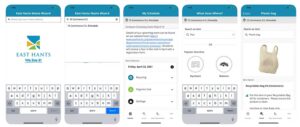
- Waste Wizard — the single most-used feature, and the workhorse behind every regulatory change. When Nova Scotia’s new packaging EPR launched on December 1, 2025, the East Hants staff rebuilt the back end to reflect the new, far more prescriptive material categories (“flexi plastics,” laminated items, and so on) — and pulled in product images directly from the Circular Materials producer responsibility organization (PRO) and brand producers so residents can match what they’re holding to what they see on screen.
- Multi-option results — Every Waste Wizard entry guides residents through the full hierarchy — reduce first, then curbside, then drop-off at the municipal depot or a special materials depot — so they pick the right path the first time.
- Collection Calendars and personal reminders — Residents can opt in to text, email, or app reminders so they never miss a pickup.
- Service Alerts — used sparingly and with discipline. East Hants’ hauler contract requires notification by 3:30 p.m. if collection will run past 6:00 p.m. When that happens, the team pushes a service alert immediately. Residents have learned that if they haven’t heard about a delay from East Hants by 6:00 p.m. then they can request a follow-up from staff (maybe missed or maybe out late).
- Campaigns and Banner Ads — both these features are pre-programmed a few months out to ensure key seasonal reminders are included in residents’ weekly reminders. Topics from summer best practices to specific holiday sorting reminders are standard focus.
- Facility Finder + custom Illegal Dumping reporting tool — built by ReCollect for East Hants in the early days of the deployment. Residents who come across illegal dumping can submit a location and details with a single click.
- Cross-departmental integration — When East Hants’ planning department issues an occupancy permit on a new home, the solid-waste team automatically receives a copy. This triggers an email to the new resident that their green-cart and mini-bin will be delivered along with information and a direct link to set up their ReCollect profile.
- In-person enablement — When the team visits seniors’ groups, they ask attendees to bring their iPads and set residents up in the system on the spot.
The thread running through all of it is that East Hants promotes ReCollect as the source of accurate and direct waste management information for the community — not as a side project. Every feature the platform provides is used as intended, as well as some updates they’ve suggested over the last ten years.
“Use it. Use all the tools. But use them as intended. Because we are selective when we use service alerts, residents have confidence that an alert signals important information that is relevant to them.”
The Results
The numbers the manager reports out to the department director and staff every month tell a story that very few municipalities — of any size — can match.
An 84% reduction in hotline calls.
In the program’s early years, East Hants was handling roughly 7,500 resident calls during the April-to-January reporting period. The most recent comparable period: ~1,200 calls. Same municipality, growing population, more programs, more material categories — and a fraction of the phone volume.
-
84%
reduction in
hotline calls -

45%
Waste Wizard
searches up
“Our calls have dropped because people can easily find the answer that they’re looking for whenever they feel like they need to ask the question — Sunday to Saturday, 24-7.”
Waste Wizard searches are up roughly 45% over the decade, with EPR for packaging launch driving a clear year-over-year spike.
Over the same April-to-January window, Waste Wizard searches climbed from 14,149 a decade ago to 20,529 — and in the first two months of the new EPR program for packaging alone (December 1 to January 31), East Hants logged 5,000 more searches than the prior year. Residents are clearly using the tool to learn the new rules.
A measurable shift from phone to self-serve.
Service tickets — covering everything from a chewed cart to a missed collection — have come down from 1,415 tickets with 1,637 touches in 2015–16 to 1,211 tickets with ~1,500 touches today, even as the municipality has grown and various EPR programs have expanded scope.
“As things change, as more regulations happen, new products get on the market — the fact that we’ve built trust with our residents that this is the source for the information it will only support increased waste diversion.”
42% of civic addresses are actively connected to the platform.
That’s the share of East Hants households the team can reach directly through reminders, the app, or service alerts. And this doesn’t even include those who might use the tool via the web portal.
A 40% combined waste diversion rate.
That figure covers all residential and commercial waste together. A curbside-tagging program runs alongside ReCollect to support the work: drivers flag address-level contamination, such as a plastic bag in a green cart or too many bags at the curb. The outreach team then uses ReCollect’s targeted service alerts to push corrective education to the affected area.
Visibly happier staff.
Andrea recently briefed her newer team members — many of them hired since 2020 — on what call volumes used to look like. Their reaction said as much about the tool as any chart could.
“We can’t imagine getting that many calls in a day.”
A model for small municipalities everywhere.
East Hants continues to prove that innovation is not limited by population size. By leveraging available resources and focusing on continuous improvement, the team has created a communication system that is efficient, standardized, and a resident engagement program that has become a valuable example for other municipalities looking to strengthen community connection.
“Benefits aren’t limited to large organizations. In many ways, smaller organizations stand to gain just as much or more. It’s not a large-organization solution – it’s a universal one.”
 North America
  United Kingdom