Customer Story
Enhancing Recycling Communications at Newcastle City Council

Newcastle City Council’s waste strategy starts with a vision: “We want our Newcastle to be a clean, green and sustainable city that wastes less and recycles more.”
The paper then goes on to outline some key themes, including behaviour change and education, waste prevention and reuse, and collection operations, each of which the council sees as critical to delivering on their vision. It also describes their ambitions for the waste service, which include: changing the way people, businesses and organisations think about waste; maximising the quality and quantity of reuse and recycling; and minimising the use of landfill.
“Recollect has helped Newcastle transition to a digital engagement strategy. Taking a transformational approach to waste management is and will continue to be critical to ensuring the city operates within sustainable environmental and financial limits.”
As a city council, Newcastle is responsible for the collection and disposal of waste from 138,000 households in the city, together with a wide range of street-scene related services. With around 90% of homes having a weekly kerbside collection using wheeled bins, and the remaining 10% of households, mostly flats, served by shared containers where individual bins are not practicable, it costs the council around £20 million a year to collect and dispose of the city’s waste.
Newcastle’s waste strategy recognises that “taking a transformational approach to waste management is and will continue to be critical to ensuring the city operates within sustainable environmental and financial limits.”
Challenges
Newcastle has always done a lot of great work in promoting recycling. Led by Rebecca Wilson, Operations Manager in Waste and Recycling at Newcastle City Council, they have for many years run successful campaigns, through media, community events and holding pop-up recycling centres.
The ‘Leave Newcastle Happy’ campaign for example, specifically targets students, particularly focusing on the end-of-term move-out period to reduce fly-tipping and increase sustainability. These initiatives are often run in collaboration with Newcastle University, Northumbria University, and local student unions.
But challenges still remain. In Newcastle, there are varying degrees of participation across the city. The council wanted to address why some people either do not want to, or are for some reason, unable to recycle as much as they could.
Solution
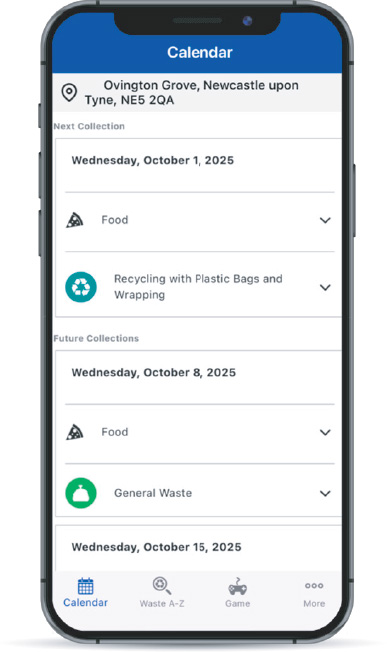
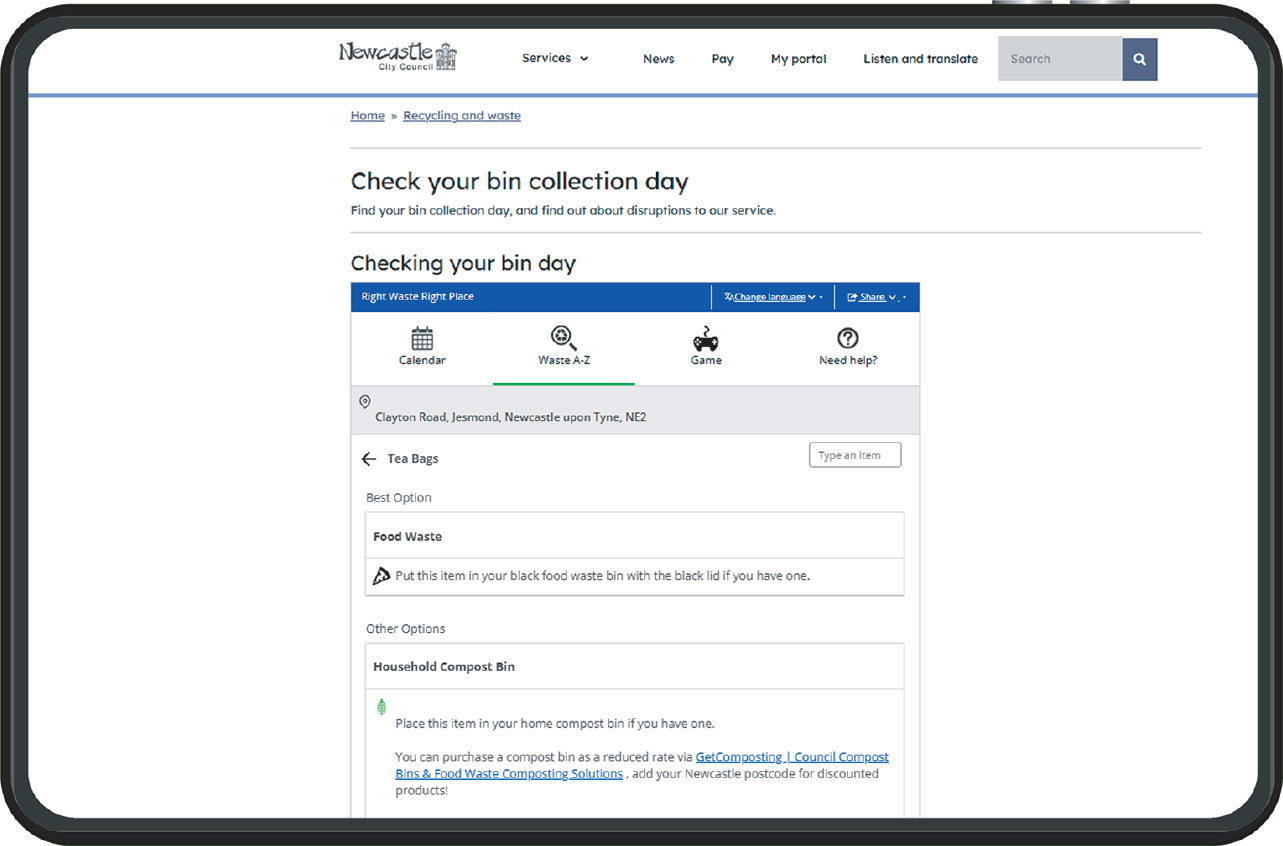
In 2024, the council entered into a partnership with Routeware to implement our ReCollect suite of digital resident education and engagement tools. The solution, which includes a web tool and mobile app, allows Newcastle residents to check collection days, sign up for service reminders and educate themselves on how to recycle correctly.
The mobile app is available for tablet or smartphone, on iOS and Android. Residents simply search “NCL Bins” or “Newcastle Bins” on the App Store or Google Play. The app is available in six different languages and is packed with helpful features to keep households informed and on track. To encourage take-up, the council promote the app with library banners, recycling‑guide QR codes, internal staff bulletins, council‑tax reminder letters, and student‑union ambassadors.
The collection calendar feature allows residents to quickly check their bin collection days. Bin day reminders send notifications straight to users’ mobile phone so they never miss a collection. Service disruption updates give real time updates about any changes to collections.
The solution also includes a recycling search tool, called the Waste A-Z, that lets residents check how and where to recycle or reuse almost anything. It contains a search tool and detailed information on hundreds of items, which makes it quicker and easier for residents to find the right information.
Both the web tool and the app also include a fun and interactive waste sorting game that lets users test their recycling knowledge.
Benefits
As Rebecca says, “Recollect has helped Newcastle transition to a digital engagement strategy”. Since their launch, the web tool and app have been used by over 75,000 addresses, creating over 14,000 reminders and viewing bin collection calendars over 1,000,000 times. Each one of these interactions is a potential phone call saved.
The tools also make it quicker and easier for the council’s waste and recycling team to maintain up-to-date information on how best to reuse and recycle items and gives them insight into how to increase effectiveness of recycling education and communications.
Commenting at the launch of the service, Cllr Alex Hay, Newcastle’s deputy leader and cabinet member for neighbourhood services, said: “We’re proud to launch the Newcastle Bins app as part of our ongoing commitment to making Newcastle a cleaner, greener, and more connected city.
“The app puts the power of information directly into residents’ hands, making it easier than ever to stay on top of bin collections, recycle right, and reduce waste. It’s a smart step forward for our city and the environment.”
Flexible Plastic Collections
Newcastle is proud to be one of ten local authorities who volunteered for the Flexible Plastic Fund’s FlexCollect Project, the UK’s most extensive pilot initiative aimed at transforming the recycling of flexible plastic packaging. Launched in June 2023, the three-and-a-half-year trial has seen Rebecca’s team at Newcastle play a pivotal role in shaping national policy and demonstrating the feasibility of kerbside collection for materials such as plastic bags and wrapping.
Beginning with 7,000 households and expanding to more than 34,000 by October 2024, the project has seen achievements include a high participation rate, with 41% of households engaged with the service, and positive resident feedback, with 95% of participants expressing satisfaction with the service, highlighting the effectiveness of Newcastle’s communication and delivery strategy.
To support the pilot, Newcastle used ReCollect to promote the collection of flexible plastics. The waste stream was identified as “Recycling with Plastic Bags and Wrapping” on resident’s digital collection calendars, with personalised campaign messages going only to households that were part of the trial. Personalised information on the A-Z also helped create positive behaviour change.
Other Service Changes – Comingled and Food Waste
In October 2025, the council transitioned to a fully commingled recycling service. Usage of their separate inset caddy for glass had declined, and more glass was being placed directly into the main bin. Going forward, Newcastle will instead see glass separated by the operator at the waste and recycling depots, making recycling for residents easier and ensuring glass is recycled in the same way.
ReCollect has helped Newcastle communicate the service change, building on the messages that were shared across social media and promoting the campaign on the bin collection page, not just the app.
Additionally, Newcastle introduced separate food waste collections to just over 5,200 households in September 2024. The digital communication tools will help support the wider roll-out of food waste collections in 2026. The council anticipate this will significantly increase recycling rates when the collections are rolled out across the city.
Conclusion
With the help of Routeware, Newcastle City Council is modernising their waste and recycling services through the use of digital communication and education tools, to improve resident engagement and boost recycling rates. By supporting new initiatives like flexible plastics and food waste collections, these efforts will also help create a cleaner, greener city and address challenges in increasing recycling participation.
 North America
  United Kingdom