Customer Story
How Tidy Services Cut Billing Cycle Time From Five Days to Hours With Routeware Elements
The Challenge
Tidy Services operates across an impressively wide footprint for a regional waste company: solid waste, liquid waste, roll-offs, portable toilets, restroom trailers, fencing, and grease and septic. That diversity is a competitive strength—but it also means the back office and field operations have to stay in sync across multiple service types, every single day.
Before partnering with Routeware, Tidy relied on a legacy AMCS platform that had been acquired and effectively discontinued. The system handled billing adequately, but routing processes were still analog: drivers received paper lists each morning and relied on memorized local knowledge to complete their runs. When a route needed to change mid-day, the workaround was to print a new sheet, photograph it, and text it to the driver.
“Not only do I hate paper—[our business] owner was looking to do something different and wanted Tidy to stand out from competitors in the area. He was open to exploring how technology could affect us.”
Billing compounded the problem. Processing a billing cycle took up to five days, and without digital proof of service, the team had no systematic way to verify work in the field or defend against customer disputes. Scale tickets for roll-off jobs traveled on paper from the driver to the billing desk—missing or delayed tickets meant billing errors and gaps. As Tidy added service lines and grew its route density, the cracks in the old system widened.
Tidy’s challenges were not unique. Broadly speaking, the portable sanitation industry is still catching up to the tech opportunities now available to fleets. As a member of the Portable Sanitation Association International (PSAI) for over 30 years—and now a board member and treasurer—Steve Ritter, General Manager at Tidy Services, hears the same conversation at every conference: operators know they need to modernize, but many are still on paper or fragmented systems that don’t connect billing, routing, and field operations in one place.
The biggest thing that I hear is: using technology to increase efficiency. And for most of us right now, that’s just routing. As soon as we understand the routing part, then we can work on efficiency of vehicles and gas mileage—but really, if we work on the efficiency of routing, it’s going to help everything else down the line.” — Steve Ritter, General Manager, Tidy Services
The Opportunity
In 2025, Tidy adopted Routeware Elements to bring together dispatch, billing, routing, and field data across all of its service lines on a single platform. The transition eliminated paper routes and unlocked a set of capabilities the old system simply could not provide.
Photo capture as proof of service
One of Tidy’s most deliberate product decisions was turning on mandatory photo capture for every service stop—and disabling the gallery option so drivers must photograph the job live, on-site. The result is a timestamped, real-time record for every completed stop.
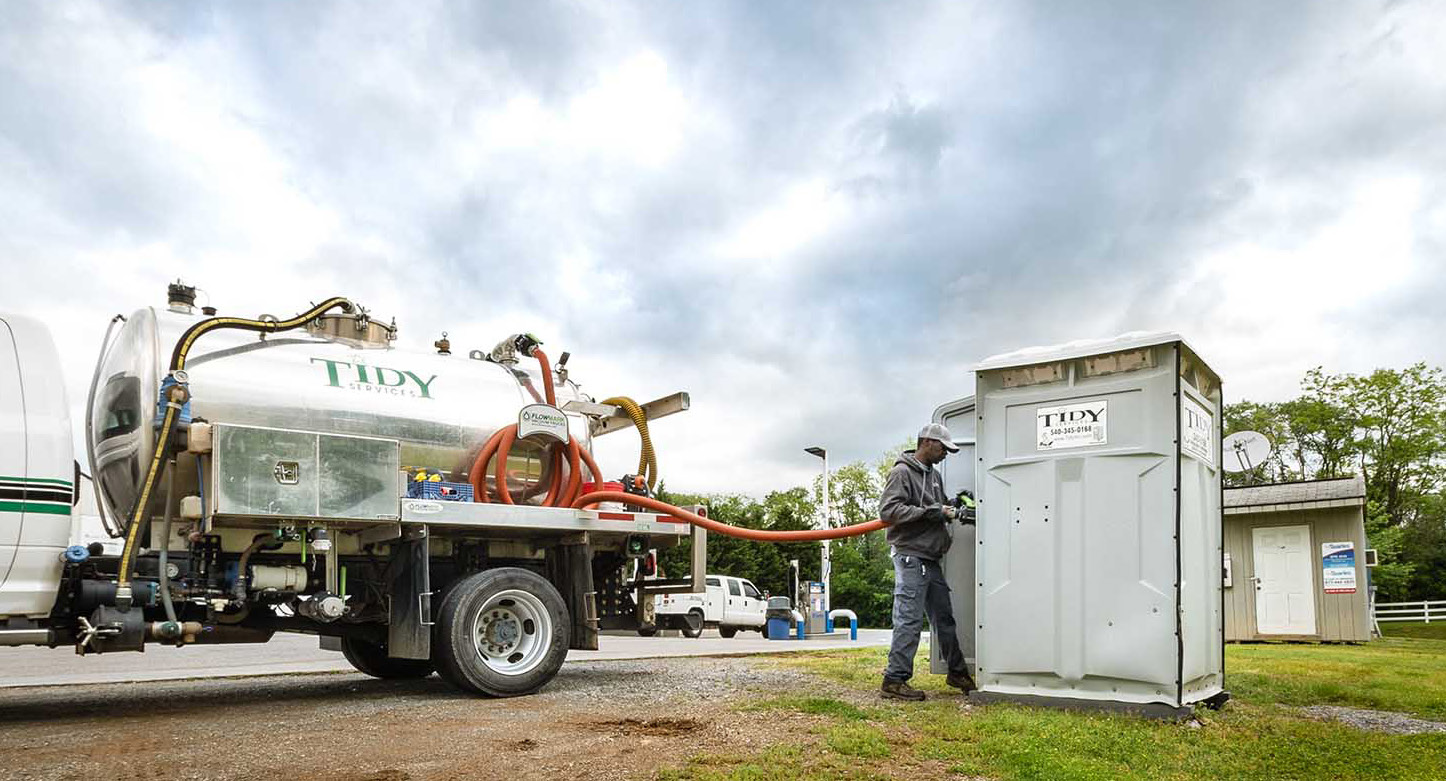
“We wanted pictures because we saw it as an ‘Amazon moment’. When Amazon delivers a package, they take a picture—and it’s proof. It backs up the customer. And there’ve been times when that’s protected us: the customer says you weren’t there, we say we were. We can use it in either direction—to prove we did what we needed to do, or to acknowledge what we couldn’t do but promised to.”
For roll-off jobs, drivers also photograph scale tickets in the field. The billing team receives both the service photo and the scale ticket image in real time—eliminating the paper handoff and giving the office a complete record before the truck returns to the yard. Scale ticket photo capture is now effectively 100% on covered routes.
NFC tag scanning for equipment accountability
Every piece of equipment—portable toilets, roll-offs, and restroom trailers—carries an NFC tag that drivers scan with their phones to verify service completion. Tidy grades drivers on tag scan rates and links incentives to compliance, creating a measurable quality standard across the fleet. A recently introduced enhancement that displays a real-time scan confirmation on the driver’s screen has already reduced dispatch interruptions caused by drivers calling in to verify whether a scan registered.
Route optimization across a diverse fleet
With paper eliminated, Tidy began using Elements’ route optimization to sequence stops efficiently across service lines. The impact was immediate: route optimization removed the dependency on individual driver knowledge, making it easier to bring on new drivers and absorb route changes with minimal lag time.
“Route optimization had a big impact right away. I don’t need a guy that has the knowledge—I just need a guy that can read a map.”
Real-time dispatch visibility
The dispatch board gives the office team a live view of every driver’s progress across all service lines. In one recent example, an emergency call came in roughly an hour away. Instead of dispatching from the yard, the team spotted on the board that a driver had just completed a nearby stop—rerouting that driver saved an hour of drive time. “We couldn’t have done that with an old system,” Steve noted.
Acquisition planning with mapping
When Tidy evaluates smaller operators for acquisition, the team now loads the target’s stop data into Elements and overlays it against their existing routes. What was once a judgment call is now a visual map—showing at a glance how well the new stops integrate and where density exists to support growth.
“I never could do that before with the old system, because I couldn’t show a map of every stop that I go to. Now it’s part of our pitch when we talk to a company about acquiring them.” — Steve Ritter, General Manager, Tidy Services
-
20%
reduction in time on the road
-
10%
savings in fuel costs
-
5
days → hours billing cycle time
The Results
The shift from legacy tech and paper processes to Routeware Elements produced measurable gains across routing, billing, customer service, and field operations—while laying the foundation for capabilities Tidy is still building out.
Routing efficiency
Route optimization delivered an immediate ~20% reduction in time on the road when Tidy first rolled out Elements. Fuel costs dropped roughly 10% in the same period. As Tidy has expanded into new service areas and grown its customer base, the underlying efficiency of Tidy’s tech-enabled routing prowess continues to support growth without requiring proportional headcount increases in the field.
Billing speed and accuracy
Billing that once required a five-day cycle now closes in a day or less. The combination of live photo capture, digital scale ticket images, and an integrated billing workflow has reduced errors and the back-office staffing needed to manage accounts receivable.
“In the very beginning, the biggest impact in a good way was on billing. Instead of a five-day process, it became a one-day—or a several-hour—process. And it’s made a financial impact: definitely fewer billing errors, because it’s just so much easier to do it how we need to do it.”
A Partnership Built on Collaboration
Like any new and evolving platform, Elements has grown through close collaboration with operators like Tidy. Steve credits an increasingly tight feedback loop—where requests from the field move quickly into product development—as an essential feature of Routeware and Tidy’s working relationship. The NFC tag confirmation enhancement currently in beta is a direct result of that process.
“We feel noticed and valued. I feel like our voice is heard, and as we give ideas for enhancements—for things that just aren’t working quite well—you hear us, you listen to us, and you try to make things better. I would 100% back that up any day.”